
Purchasing habits in Greece have evolved significantly over the last few years, led by rapid digitalization and new EU policies. The prevalence of online transactions has grown, mobile-based shopping has surged, and delivery times are shorter than ever, thanks to the development of locker networks.
The Greek e-commerce market was valued at 34 billion USD in 2025 and is expected to reach 59 billion by 2031, growing at a solid 9.38% annual rate.
Still, businesses looking to operate in Greece must be aware of its specific market dynamics.
Trust is harder to earn in Greece, especially for lesser-known merchants. Shoppers look for clear signals before completing a purchase: familiar payment methods like debit cards and cash-on-delivery, visible contact details, and presence on trusted platforms like Skroutz. Even small gaps, such as an unfamiliar checkout or missing local cues, can lead to abandonment.
Knowing and respecting these dynamics is key to business success. This guide provides 5 tips to help you grow your business online in Greece, focusing on what makes this market different and what it takes to actually convert Greek shoppers.
Key takeaways
- Greek e-commerce is growing, but trust is the real barrier to entry.
Greek consumers are more cautious than their Western European counterparts. Earning trust requires localized checkout flows, recognized payment methods, and visibility on platforms like Skroutz.
- A localized, mobile-friendly checkout is necessary.
The majority of transactions occur on smartphones, and cart abandonment is high. To prevent buyers from leaving, offer a mobile-optimized checkout in the local language, along with fast load times and familiar payment options.
- Greek shoppers expect specific payment methods.
Debit cards dominate online spending, cash-on-delivery is still commonplace, and digital wallets and BNPL are growing among younger, credit-cautious consumers. Offering the right mix of methods signals legitimacy and boosts sales.
- Localization goes beyond language.
You can build trust with locals by adapting your website, checkout, and marketing strategy. Native Greek content, EUR checkout flows, Viber and WhatsApp support, and local SEO aligned with tourism cycles all contribute to a localized experience.
- Paypercut gives you the payment infrastructure Greece requires.
One integration covers cards, wallets, Buy Now, Pay Later, payment links, and QR codes, and checkouts are fully localized for Greece and compliant with local regulations. The same setup extends to 20+ other European markets if you decide to expand.
The state of e-commerce in Greece
E-commerce in Greece isn’t as prevalent as in other European countries. For many Greek businesses, online is still one of several channels, not the primary one. According to the State of Greek eCommerce 2025 survey, about a third of merchants earn less than 25% of their total revenue from online sales, while only 41% earn more than 50%.
Still, the trajectory is upward. E-commerce penetration has been rising, while the average online spending has been decreasing. These trends could signal that online shopping is becoming more of a standard utility rather than an occasional luxury. The dominant e-commerce category is fashion, followed by beauty, personal care, and electronics.

Greek shoppers often rely on marketplaces like Skroutz and BestPrice not just to buy, but to validate where they buy from. These platforms act as a trust layer, where users compare prices, read reviews, and assess merchant credibility before deciding to complete a purchase. Many customers discover a business through a marketplace and only then decide whether to buy directly from the merchant.
On the payment side, debit cards dominate, while cash-on-delivery is still prevalent, with over 85% of e-shops offering it. This payment profile is a lasting effect of the economic crisis, which left many Greeks cautious about banks and credit. Still, newer methods such as digital wallets and Buy Now, Pay Later have been gaining ground recently.
The key to succeeding in the Greek market is earning customers’ trust. Local giants like Skroutz are the standard because they’re familiar and long-standing, and have peer rating systems that customers can rely on when making purchasing decisions.
To succeed alongside these platforms, you need to give Greek customers what they expect and more. You need to provide a localized, mobile-first store experience, their go-to payment methods, as well as competitive prices, great customer service, and fast delivery.
5 tips to grow your business online in Greece
Greece’s e-commerce infrastructure, consumer habits, and trust dynamics create both challenges and opportunities. The following sections offer tips for business success, focusing on areas with the biggest impact locally:
1. Build a mobile-friendly website and checkout
A website serves as your storefront, portfolio, and brochure. It should provide a satisfying user experience from the moment the customer enters until after checkout. Otherwise, it may frustrate your visitors, leave a negative impression of your business, and deter potential buyers.
This is especially true at checkout, where even small friction points, such as slow loading and too many form fields, can turn a completed browse into an abandoned cart. In Greece, cart abandonment rates sit high, around 75%.
Pro tip: EU regulations mandate transparency about your business details, products, services, and payment terms, so make sure all information is up-to-date and clear.
The good news is that your website doesn’t need to be expensive to be successful. In the State of Greek eCommerce 2025 survey, 47.2% of merchants claimed to spend only between €0 and €1,000 per month on their tech stack.
However, your website and checkout need to be mobile-friendly. Here’s why:
- 64% of transactions in Greece in 2025 occurred on smartphones, which makes mobile checkout performance critical. A mobile-first experience means fast loading times, minimal input fields, clear and prioritized payment method selection, and a frictionless flow from product to payment. Even small usability issues on mobile can lead to high drop-off rates.
- 84.9% merchants have mobile-optimized websites.
- 7.5% of merchants have a dedicated mobile app.
Smaller websites in Greece usually have no mobile strategy at all, yet they need it the most in order to gain local consumers’ trust and grow.
2. Sell where Greek shoppers already look
If you manufacture goods or run an e-commerce store, consider selling your products on one of the local marketplaces:
Skroutz, for example, began as a price comparison website in 2005 and is now a leading marketplace in Greece. The platform saw a 21% increase in orders in 2025 compared to the previous year.
Besides marketplaces, take advantage of local business search directories such as XO, Vrisko, and 11888, and ensure your information is consistent across all websites. Conflicting details across platforms raise red flags for potential customers.
Greeks trust marketplaces and directories, and use them to compare prices, read reviews, and verify a store’s legitimacy before buying. Being listed there signals credibility in a way that your website can’t replicate on its own.
3. Offer the payment methods Greek shoppers expect
Payment method availability in Greece is a trust signal and conversion lever. If your checkout doesn’t show the methods customers recognize and prefer, they’re more likely to abandon the purchase than enter their details into something unfamiliar.
Cards are the most common online payment method in Greece. They accounted for 60.4% of the country’s online spending in 2025. Debit cards are the preferred type, and they make up around 90% of card transactions.
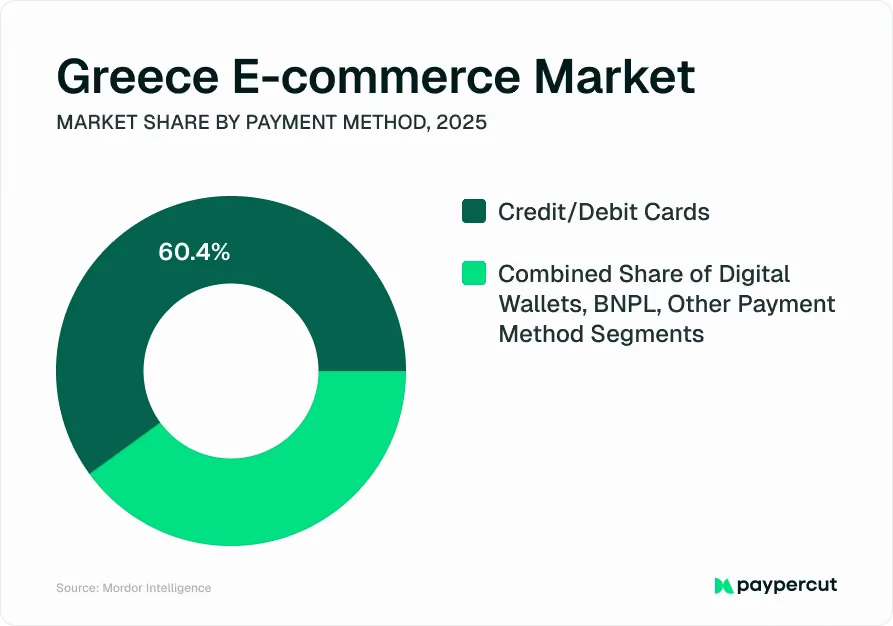
While not nearly as popular as cards, digital wallets have been gaining ground, especially among younger online shoppers. The case is similar for Buy Now, Pay Later (BNPL), which lets customers pay in installments. This method appeals to a generation that's cautious about credit and often has limited access to it.
Although its use is slowly declining, cash-on-delivery remains widely used in Greece, largely due to long-standing caution around online payments and low trust in unfamiliar merchants. Many shoppers prefer to pay only when the product arrives.
To increase card or BNPL adoption, businesses need to actively build trust by offering recognizable payment methods, clearly communicating security, and reducing friction at checkout, especially on mobile.
Your business should offer a variety of payment methods to cater to as many customer segments as possible. However, this can pose a practical problem for many merchants, as offering multiple methods means managing separate providers, contracts, and integrations for each. This is where Paypercut can be a valuable asset.
Bring all required payment methods into one place
Offering the right mix of payment methods in Greece often means working with multiple providers, contracts, and integrations. This creates operational complexity and slows down expansion across markets.
Paypercut simplifies this by combining cards, digital wallets, BNPL, payment links, and QR codes into a single platform with one integration. Merchants can launch faster, manage everything from one dashboard, and offer a checkout experience that matches local expectations without additional operational overhead.
With Paypercut, you can have a fully localized checkout that:
- Is set up in EUR
- Complies with local regulations
- Is ready to go without paperwork
- Doesn’t require lengthy approval processes
Through a single integration, you can offer cards, digital wallets, BNPL, payment links, and QR codes, and manage them all from one simple dashboard.
Paypercut also comes with a BNPL aggregator, which is particularly useful for the Greek market. Rather than locking you into a single option, Paypercut connects you to multiple providers through one integration. Your customers choose the option that works best for them at checkout, and you receive full payment upfront, regardless of the provider.

Integrating Paypercut with your store is easy, as the platform offers both APIs and ready-made plugins for Shopify, WooCommerce, and OpenCart. There are no setup fees, monthly charges, or lock-in commitments—you only pay per transaction.
And if you decide to expand your business to Romania, Bulgaria, or any of the 20+ other European markets Paypercut covers, the same setup and contract carry over.
Get started with Paypercut and launch a localized checkout for Greece in days.
4. Localize your website and marketing strategy
It’s important to have a website in Greek, as well as a localized payment flow with EUR currency display. If you localize your storefront but skip the checkout, this can erode trust and lead to cart abandonment.
Customer support channels are another localization gap many businesses overlook. Greek consumers expect to reach businesses through Viber and WhatsApp. These are the dominant messaging apps in the country. Offering only email-based support comes across as distant or out of touch with local expectations.
Marketing and acquisition strategy is the biggest operational pain point for Greek businesses, especially small ones, but localizing your strategy can make a difference. The top sales-driving channels in the country are:
- Google Ads: 41.5%
- Social media advertising: 24.5%
- Search engine optimization (SEO): 20.8%
The top-performing social media channel for businesses is Facebook, though it’s usually more common among large businesses. Instagram is also highly popular, especially for SMBs. TikTok ranks third and is generally favored by younger audiences.
When it comes to SEO and paid ads, pay attention to the following:
- Language: Conduct keyword research and create your website and other content in native Greek instead of English or Greeklish (Greek written in the Latin alphabet).
- Local SEO: If you have a physical store, create a Google Business Profile. Add your company information and high-quality images, and use location-specific keywords.
- Seasonal SEO: Tourism plays a significant role in Greece’s economy, and its busiest season is Easter to October. Align your SEO strategy with fluctuating search demands with seasonal keywords, product pages, and content.
5. Plan for cross-border from the start
Most Greek e-commerce businesses are domestically focused today. Only 11.4% have a meaningful share of foreign customers. But if you're in a sector with natural cross-border appeal, such as tourism products, specialty foods, or cosmetics, the demand exists. The friction is in the infrastructure.
Each market brings its own challenges, from local payment methods and currencies to settlement processes and customer expectations. For example, selling in Poland often requires BLIK and PLN, while other markets may rely more on cards or BNPL.
Without the right setup, this creates friction in checkout and directly lowers conversion rates. Businesses that plan for these differences early can expand faster without rebuilding their payment infrastructure for every new country.
If you plan to expand, choose a payment platform that makes it easy to reach your target countries, as Paypercut does for CEE. Even if expansion isn't on your roadmap yet, choosing infrastructure that supports it means you won't have to re-platform when the opportunity comes.
Frequently asked questions
Why should you expand your business to Greece?
Greece's e-commerce market is valued at 34 billion USD in 2025 and is projected to nearly double by 2031. The economy has been growing steadily, with GDP rising 2.1% in 2025—nearly double the EU and eurozone averages.
At the same time, the market is less saturated than Western European countries. For businesses that invest in localization and earn local trust, Greece offers strong growth potential with less competition than more mature markets.
Which e-commerce businesses are most profitable in Greece?
According to Statista Market Insights from late 2024, the highest average revenue per user in Greek e-commerce is in fashion, followed by (in this order):
- Beauty and personal care
- Electronics
- Diy and hardware store
- Household essentials
- OTC pharmaceuticals