


If you run a SaaS business in Poland, there's a good chance PayU was your first payment provider. Your Polish customers know the name, the checkout feels familiar, and it lets subscribers pay their renewals with BLIK, which plenty of providers still can't do.
But once you have more subscribers, there’s more to think about than whether a payment goes through. You have plans to manage, failed renewals to deal with, customers upgrading or downgrading, and maybe new markets to launch in.
So if you’ve started to look at PayU alternatives, the important differences are pretty practical: can customers still renew with BLIK, how much of the subscription setup will you have to manage yourself, and what will each renewal actually cost?
Key takeaways
- Recurring BLIK is one of the biggest differences between providers, especially for Polish SaaS businesses with local subscribers.
- Stripe and Paddle handle more of the billing work, while PayU, Tpay and Przelewy24 leave more logic in your product.
- Fixed fees can have a big impact on lower-priced plans, so compare the real cost of each renewal, not just the headline rate.
- Paypercut is a strong fit for Polish SaaS teams expanding across Europe that want recurring billing without a heavier billing stack.
PayU alternatives for Polish SaaS at a glance
*Prices checked October 2026
Paypercut: for Polish SaaS teams selling across Europe
Plenty of payment platforms work in Poland. Fewer are built around how CEE businesses grow, usually one neighbouring market at a time.
Paypercut is an online payments platform built for exactly that. Compared to PayU, the difference shows up when you add a second market: you keep the same payment setup instead of starting over.
- BLIK on renewals: not publicly documented. BLIK is supported for one-off checkout payments, while Paypercut's subscription documentation currently describes renewals using reusable payment methods.
- Subscription tools: plans, automatic renewals, failed-payment recovery and webhooks through billing & payouts.
- Pricing: 1.29% + PLN 0.25 for EEA consumer cards and BLIK, 2.69% + PLN 0.25 for other cards, on published Polish pricing.
- Watch out for: weekly or monthly plans only, no usage-based billing, and no built-in MRR or churn reporting.
There are no activation, monthly, PCI or refund fees, and payouts go to the bank account you already use. If you're early-stage, Paypercut for startups is worth a look.
It also fits best when your startup needs a multi-market payment provider, so you're not rebuilding payments for every new country.
Stripe Billing: for SaaS teams that want the billing engine included
Stripe is where a lot of SaaS founders start, and its billing tools are the reason.
Compared to PayU, Stripe Billing takes plans, invoices and failed payments out of your codebase. Trials, upgrades, proration and a customer portal come built in.
- BLIK on renewals: Supported for eligible Stripe accounts, subject to activation and BLIK recurring-payment requirements.
- Pricing: 1.5% + PLN 1.00 for EEA cards and 1.6% + PLN 1.00 for BLIK, on Stripe's Polish pricing. Billing adds 0.7%.
- Watch out for: the PLN 1.00 fixed fee on cheap monthly plans. Telecoms, insurance and gambling can't use recurring BLIK.
Paddle: for teams that would rather not handle VAT

Paddle is the odd one out. It's a merchant of record, so Paddle legally sells your product to your customer.
That means Paddle handles tax, invoices, refunds and chargebacks. For a small team selling software, digital products or online courses in many countries, that's a lot of admin gone.
The trade-off is cost and control. You pay 5% + USD 0.50 per transaction, and invoices come from Paddle, not you.
BLIK is also limited to one-off purchases in PLN. Your BLIK subscribers would need a card for renewals.
Tpay: for staying local with BLIK renewals

If you want to keep a setup similar to PayU, Tpay is the closest swap.
The Polish operator's API supports BLIK Recurring Payments (Płatności Powtarzalne BLIK). Subscribers who renew with BLIK can keep doing so.
The split of work doesn't change. Tpay collects the payment, and your app still runs the subscription.
Recurring pricing is quoted, so ask for one written offer covering both BLIK renewals and cards.
Did you know? BLIK recurring payments grew twenty-fold to 3.6 million in the first half of 2026, according to BLIK. The average one was PLN 46, about the price of an entry-level SaaS plan.
Przelewy24: for published Polish rates
Przelewy24 is one of Poland's largest payment operators, part of Italy's Nexi Group. Compared to PayU, you can see its standard rates without asking.
Przelewy24's fee table lists 1.29% + PLN 0.30 for cards and BLIK. There's a PLN 59 activation fee, refunded after 10 transactions in your first two months.
For a SaaS business, though, the recurring-payment pricing matters more than the headline rate. Recurring Billing is priced individually, so the public rate may not be your renewal rate.
The offer also doesn't say whether BLIK renewals are included, so ask.
How to compare PayU alternatives for a SaaS business
Three questions will narrow the list faster than any feature page.
Can your subscribers renew with BLIK?
Most providers support BLIK at checkout. Far fewer support BLIK on renewals, and that's what matters for a subscription.
Here's how it works for your customer. They enter a BLIK code once and approve the arrangement in their banking app.
After that, renewals go through without a new code. They can cancel the mandate in their banking app at any time.
Two limits are worth knowing:
- Transaction limits. Recurring BLIK can have provider- and model-specific transaction limits, so check the limit that applies to your integration.
- Limited bank coverage. Not every Polish bank supports recurring BLIK yet.
Recurring BLIK can work well for monthly subscriptions, but check the transaction limits and supported banks before offering it for higher-value plans. If a renewal exceeds the limit available through your provider, customers will need another payment method, such as a card or bank transfer.
If a subscriber's bank doesn't support recurring BLIK, the recurring setup can fail. Show the supported banks before the BLIK step and keep card payment available as a fallback.
How much subscription logic do you want to own?
"Supports recurring payments" can mean two very different things, and this is where a lot of switching decisions go wrong.
The charging layer stores a card or BLIK token and collects money when asked. The billing layer decides when to ask and what happens next. For a SaaS business, that means:
- Monthly and annual plans
- Trials, upgrades and proration
- Retries and dunning emails
- Customers updating their own card
- MRR and churn reporting
- PayU, Tpay and Przelewy24 focus more on payment collection than on providing a full SaaS billing stack, so more subscription logic may remain in your product.
- Stripe Billing and Paddle cover plans, billing workflows and revenue reporting.
- Paypercut sits in between: plans, renewals, retries and webhooks, but no metered billing or MRR and churn analytics.
What does one renewal actually cost?
For a low-priced SaaS plan, the fixed fee can matter as much as the headline percentage. On a PLN 49 monthly subscription, a Paypercut renewal on an EEA consumer card costs about PLN 0.88. The same card payment on Stripe with Billing comes to about PLN 2.08.
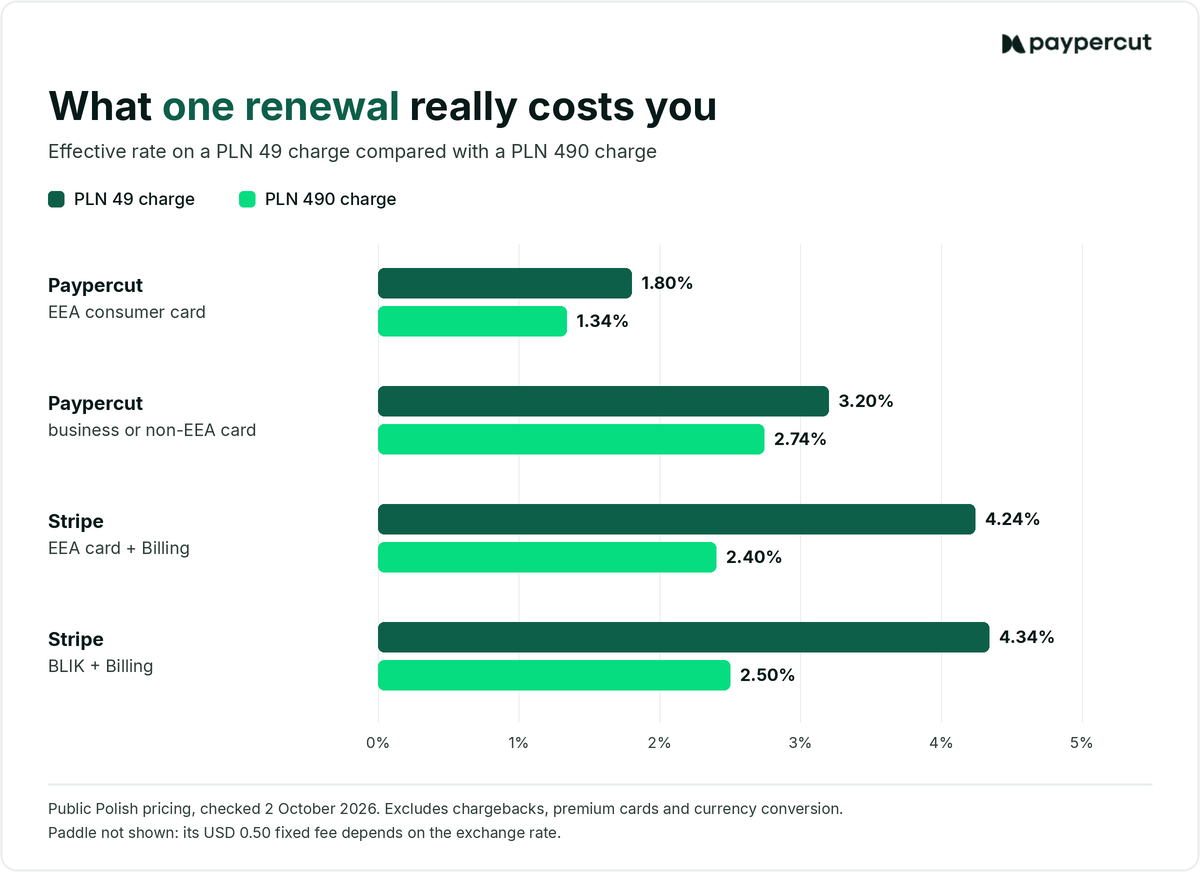
That isn't a like-for-like comparison. Stripe's additional 0.7% pays for a much deeper billing engine, while Paypercut leaves more of the revenue stack in your own product. The point is to compare the full cost of each renewal, not just the percentage on the pricing page.
What about PSD2 SCA and KSeF?
For card subscriptions, SCA usually applies when the subscription is created or changed, not on every renewal.
Under the PSD2 rules, SCA is required when a payer creates, amends or first initiates a series of recurring transactions with the same amount and payee, as the European Banking Authority confirms.
In practice, a normal fixed-price renewal can usually go through without asking your subscriber for 3-D Secure again. When the arrangement changes, say on an upgrade, they may need to authenticate again.
KSeF is separate from your payment provider.
Mandatory KSeF invoicing started on 1 February 2026 for businesses with more than PLN 200 million in 2024 gross sales and on 1 April 2026 for most other businesses.
The smallest businesses with no more than PLN 10,000 in monthly gross sales documented by invoices remain temporarily exempt until 1 January 2027, according to the official KSeF implementation schedule.
So your invoicing or accounting setup carries KSeF, not your payment provider. Switching from PayU to Stripe, Tpay, Przelewy24 or Paypercut won't make that obligation disappear.
Paddle is the exception. As merchant of record, it issues invoices to the buyer as the seller.
How to switch from PayU without disrupting subscribers
The real risk in switching is a wave of failed renewals in the first month. A staged migration makes that much less likely.
Start with stored cards, and don't assume your PayU tokens will come with you.
PayU documents an import process from other operators. Before planning the reverse move, get it in writing that PayU can export your stored credentials and your new provider can import them.
Recurring BLIK authorisations are tied to the existing payment setup, so assume subscribers may need to approve a new recurring arrangement when you change providers unless portability is explicitly supported.
A low-risk order of work:
- Test renewals in the new provider's sandbox.
- Send new signups to the new provider first.
- Move existing subscribers gradually. Ask them to update payment details only where stored credentials or mandates can't be migrated.
- Keep PayU live until the last subscriber has moved.
- Export your full transaction history before you close the account.
Start with one plan or customer segment. A month of real renewals shows you more about retry timing and webhook behaviour than any sandbox test.
Narrow it down using your own PayU data
A useful place to start is your own PayU data. Look at the last three months of transactions and answer three questions.
- How many of your renewals use BLIK? If BLIK subscribers are a big part of your base, start with providers that support recurring BLIK, and confirm it's available for your account before you migrate.
- How much billing logic already lives in your product? If plans, retries, proration and card updates are already built, you may not need Stripe Billing or a merchant-of-record model.
- Where are you selling next? If Poland is your only market, Tpay and Przelewy24 deserve a close look. If other European markets are on the roadmap, compare how much new payment setup each expansion would take.
If other European markets are part of your growth plans, Paypercut is worth comparing more closely. You keep Polish payment methods and recurring subscription tools on one platform as you grow. If you need metered billing or built-in SaaS revenue analytics, you'll still want extra tooling alongside it.
Test your renewals before you move a single subscriber
Register with fully digital onboarding and build your subscription flow in the sandbox while verification runs.
FAQs
Does the payment provider support BLIK alongside card payments for Polish customers?
All five alternatives offer BLIK next to cards at checkout, though Paddle limits it to one-off PLN purchases. Renewals are the real difference. PayU, Stripe and Tpay support recurring BLIK. Paypercut's recurring billing currently documents stored cards and digital wallets, while Paddle supports BLIK only for one-off purchases.
Do PayU alternatives offer recurring billing built for SaaS metrics, not just generic subscriptions?
Stripe Billing and Paddle do, with plans, proration, dunning and revenue reporting built in. PayU, Tpay and Przelewy24 collect recurring payments but leave more logic to your product. Paypercut handles plans, renewals and retries, without MRR or churn analytics.
Does switching away from PayU disrupt existing subscriber payments?
It doesn't have to if you migrate in stages. Confirm in writing whether PayU can export stored card credentials, and expect BLIK subscribers to approve a new mandate. Move new signups first, then existing subscribers at renewal.
How do fees compare between PayU and other providers for recurring transactions?
On a PLN 49 monthly plan, one renewal costs PLN 0.88 on Paypercut with an EEA consumer card and about PLN 2.08 on Stripe with Billing. Paddle charges 5% plus USD 0.50 but includes tax handling. PayU, Tpay and Przelewy24 quote recurring pricing per merchant.
Does the alternative meet PSD2 SCA and local invoicing compliance requirements?
For fixed-amount recurring card payments, SCA generally applies when the arrangement is created or changed rather than on every renewal. KSeF is separate and sits with your invoicing setup, not your payment provider. Paddle is different because it invoices as merchant of record.