
To accept BLIK payments in Poland, you normally enable it through a payment provider or bank that already supports BLIK, rather than integrating with BLIK directly. You price the order in złoty, and your customer approves the payment in their banking app.
So the real decision is which provider you add it through. There are three realistic routes: a Polish payment gateway, an international platform, or a regional platform built for Central and Eastern Europe.
All three routes can give you access to BLIK, depending on the provider you choose. Where they split is the price of one order, where your złoty end up, and how much else the same setup can do for you.
Key takeaways
- BLIK is a core payment method for Polish online shoppers.
- Online BLIK payments are processed in PLN and enabled through a payment provider or bank.
- Compare the cost of one order, not the percentage.
- Paypercut lists BLIK at 1.29% + PLN 0.25, alongside cards and wallets.
How BLIK works at an online checkout
BLIK is Poland's mobile payment system, run by Polski Standard Płatności and built into the banking apps of Polish banks. For an online store, a BLIK payment runs in four steps.
- The customer picks BLIK at checkout. It appears next to cards and wallets as one more method.
- They open their banking app and copy a six-digit code. According to BLIK, the code is single-use and valid for two minutes.
- They enter the code in your checkout. Their bank then sends a push notification asking them to approve the payment.
- They confirm in the app, and you get the result. The customer approves the payment in their banking app, and your checkout receives the payment status.
Two things follow for you as a merchant.
First, online BLIK payments are processed in Polish złoty. Your provider's settlement setup is a separate question: check whether you can receive PLN into your existing account, whether a PLN account is required, and whether currency conversion applies. In practice, your store needs to show złoty prices before BLIK can appear at checkout.
Second, the customer never types card details. They authenticate inside an app they already trust, which is part of why BLIK is so widely used.
Why Polish shoppers expect BLIK at checkout
The short answer is scale. BLIK is no longer one option among several when you accept payments in Poland. It's the method Polish online shoppers name most often.
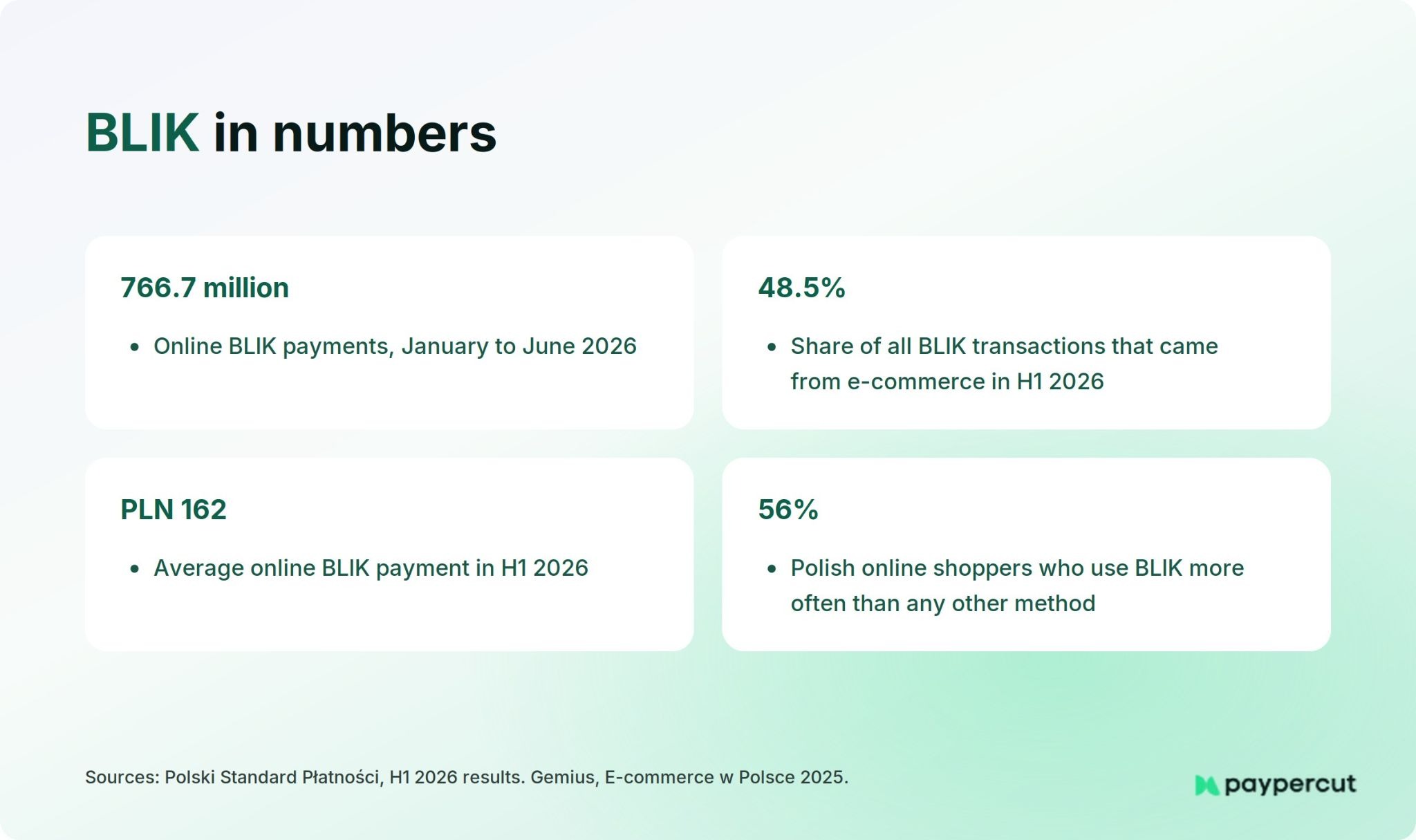
A 2025 report found that 56% of Polish online shoppers surveyed name BLIK as the payment method they use most often, compared with 20% for fast bank transfers.
The operator's own figures point the same way. In its H1 2026 results, Polski Standard Płatności reported:
- 766.7 million online BLIK payments between January and June 2026, worth PLN 124.5 billion
- 48.5% of all BLIK transactions came from e-commerce
- An average online payment of PLN 162
- 21.6 million active users at the end of June
- A twenty-fold rise in recurring BLIK payments, to 3.6 million, now offered by more than 100 partners including Allegro and OpenAI
For you, this makes BLIK a checkout consideration, not just an extra payment option.
If a Polish customer reaches your checkout and doesn't see the method they normally use, they have to switch to another way to pay. That adds friction at the point where you're trying to complete the sale
Three ways to add BLIK to your checkout
Here is how the three routes compare on the points that decide the choice. BLIK prices below are published standard rates, checked on 29 September 2026.
Route 1: A Polish payment gateway
This is the natural choice if Poland is your whole market. Polish gateways have run BLIK for years, and they bundle it with the other payment methods Polish shoppers use.
Take Przelewy24 as the example. Its public commission table charges 1.29% + PLN 0.30 for BLIK, the same rate as its online transfers, cards and wallets. There's a PLN 59 activation fee, refunded once you complete 10 transactions in the first two months, and no monthly subscription.
The small print is where the fit shows. The first four PLN payouts a month to a Polish bank are free, then PLN 0.99 each. A payout to a foreign bank costs PLN 40. Recurring payments and one-click payments are priced individually rather than published.
If you also sell into Czechia, Romania or Germany, check how far the gateway's coverage extends beyond Poland. Depending on the provider and markets you need, you may still need a second setup outside Poland.
Route 2: An international platform
This route suits businesses that already sell in several countries, sell digital products or subscriptions, or have developers who want one API for everything.
Stripe is the clearest published example. Its Polish pricing page lists BLIK at 1.6% + PLN 1.00. Its documentation lists 30+ supported business locations for BLIK, including the UK, the US and much of the EU, so you don't need a Polish entity or a Polish account to accept it.
In September 2026, Polski Standard Płatności also announced that BLIK had joined Stripe's dynamic payment methods.
The trade-off is the fixed fee. PLN 1.00 per order is more than three times the fixed amount Przelewy24 charges, so the difference becomes particularly noticeable on smaller baskets. International platforms also tend to offer a narrower set of Polish-specific methods than a local gateway.
Route 3: A regional platform built for CEE
The third route sits between the other two. A regional platform treats Poland as one of several neighbouring markets rather than as either the only market or one country among 40.
What you're looking for here is local methods like BLIK in each market, local currencies, and plugins for the platforms CEE stores actually run. The point of this route is that adding Poland doesn't mean adding a provider, and adding the next market after Poland doesn't either.
Paypercut is an example of this route. It lists BLIK at 1.29% + PLN 0.25 next to cards and wallets in the same checkout, charges no extra fee for enabling a new payment method or entering a new market, and pays out to your existing business bank account.
What one BLIK order actually costs you
The headline percentage doesn't tell you the full cost. What matters is what the fee looks like on an order your customers actually place.
Use BLIK's own average online payment for H1 2026: PLN 162. At that basket:
- Paypercut at 1.29% + PLN 0.25 comes to about PLN 2.34 per order, or 1.44%
- Przelewy24 at 1.29% + PLN 0.30 comes to about PLN 2.39 per order, or 1.48%
- Stripe at 1.6% + PLN 1.00 comes to about PLN 3.59 per order, or 2.22%
At 500 BLIK orders a month, that's roughly PLN 1,170 with Paypercut, PLN 1,195 with Przelewy24 and PLN 1,796 with Stripe. A gap of about PLN 625 a month between the lowest and highest, from the same customers paying the same way.
Now drop the basket to PLN 40:
- Paypercut comes to about PLN 0.77, or 1.92%
- Przelewy24 comes to about PLN 0.82, or 2.04%
- Stripe comes to about PLN 1.64, or 4.1%
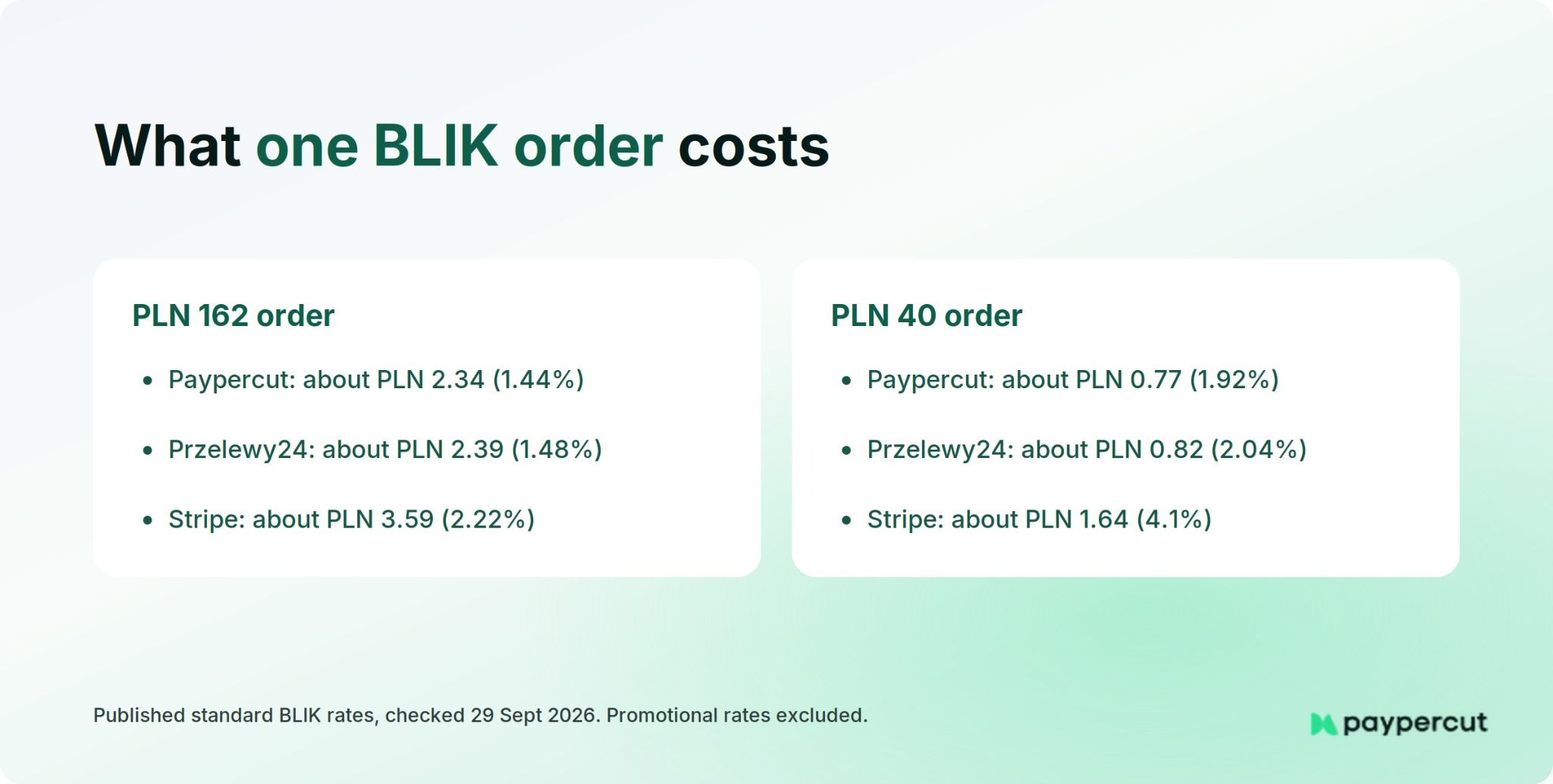
The smaller your basket, the more weight the fixed fee carries in your effective transaction cost. On large baskets, the percentage takes over again and the gap narrows.
Then add what sits around the rate: activation fees, payout fees, and any fee for converting złoty if your account is in another currency.
A provider that's cheaper per order can still cost you more if every payout to your German or Bulgarian bank carries a fixed charge. Stripe also lists an additional fee where currency conversion is required, so merchants settling outside PLN should check the applicable conversion cost.
*Pricing checked 29 September 2026. Rates vary by merchant country, customer location, business model and negotiated agreement. Promotional rates are excluded.
Ready to accept BLIK payments?
Add BLIK alongside cards, Apple Pay and Google Pay with one payment setup built for selling across CEE.
Questions to settle before you switch BLIK on
Whichever route you pick, these are the points that cause trouble after launch if nobody asked about them first, alongside the usual trust signals to look for in a payment provider.
Are your prices in PLN? Online BLIK payments are processed in złoty. If your store shows EUR by default, you need PLN pricing for Polish visitors for BLIK to be available.
Which BLIK services do you get? "BLIK support" doesn't necessarily mean every BLIK feature is included. Ask separately about the standard six-digit-code flow, recurring BLIK payments and BLIK Płacę Później, as availability differs by provider and integration.
Where do the złoty go? Ask whether you receive PLN into a PLN account, whether that account can be outside Poland, and what each payout costs. This is the question that separates the three routes most clearly.
How are refunds handled? A BLIK refund goes back to the customer's bank account, not to a card. Ask whether the provider charges to issue a refund and whether the original fee comes back to you. Those are two different questions. Paypercut, for example, doesn't charge to issue a refund, but the original transaction fee isn't returned.
How are payment issues handled? BLIK doesn't follow the same chargeback process as card payments, so ask your provider how failed payments, customer claims and other payment issues are handled for BLIK specifically.
Is there an integration for your platform? If you use WooCommerce, Shopify, PrestaShop or Magento, check whether the provider offers a maintained integration for your platform and how BLIK appears within it. Some implementations keep the BLIK code entry in your checkout, while others redirect the customer to a separate payment page.
Can you test BLIK before going live? You want to run a test BLIK payment in a sandbox, including a timeout and a declined approval, before real customers try it.
Can you run BLIK alongside cards and wallets? Yes. One checkout can show BLIK next to cards, Apple Pay and Google Pay. Check whether your provider lets you control which payment methods appear for Polish customers and how they're ordered.
How to add BLIK without building a Poland-only setup
If Poland is one of several markets you sell to, or the market you're adding next, one option is to add BLIK through the same payment setup you use across markets. That's the model Paypercut is built around.
Say you run an online store in Romania or Czechia, Poland is your next market, and you're starting to outgrow a single-market payment setup.
With a Poland-only gateway, adding BLIK can mean a second contract, a second dashboard and a second set of payouts to reconcile.
With Paypercut, eligible merchants can add BLIK within the same payment setup they already use across supported markets.
Against the questions above, here's where Paypercut lands:
- Published BLIK pricing. BLIK is listed at 1.29% + PLN 0.25. That's below both Przelewy24 and Stripe on the two orders compared above: about PLN 2.34 on a PLN 162 order and PLN 0.77 on a PLN 40 order
- One setup across markets. BLIK sits alongside cards, Apple Pay and Google Pay in the same online checkout, so Polish customers get their usual method while the rest of your checkout stays the same
- Payouts to your existing bank. No new account needed, and payouts are included in the transaction fee
- What you don't pay. No activation fee, no monthly minimum, no PCI or gateway fee and no cross-border surcharge
- Plugins for major e-commerce platforms. Paypercut offers integrations for Shopify, WooCommerce, OpenCart, Magento and PrestaShop, alongside hosted checkout and API options
Ready to accept BLIK payments?
Add BLIK alongside cards, Apple Pay and Google Pay with one payment setup built for selling across CEE.
FAQs
Do I need a Polish bank account to accept BLIK payments?
Not always. BLIK payments are always charged in PLN, but some providers accept BLIK for businesses registered outside Poland. Stripe, for example, lists 30+ supported business locations. What changes is the payout: check whether you can receive złoty into an account outside Poland, whether the provider converts them, and what each payout costs. Przelewy24, for instance, charges PLN 40 per payout to a foreign bank.
Which payment providers support BLIK for online stores?
Polish gateways such as Przelewy24, PayU and Tpay all offer BLIK, usually alongside fast bank transfers and local instalment options. International platforms including Stripe and Adyen support it too, and Paypercut lists BLIK on its published pricing. Before choosing, ask each one which BLIK services are live for your account: the six-digit code, recurring payments and BLIK Płacę Później are separate features.
Does adding BLIK actually increase checkout conversion with Polish shoppers?
There's no single conversion uplift figure that holds for every store. Gemius found that 56% of Polish online shoppers surveyed use BLIK more often than any other payment method, which shows how established it is in the market. Without BLIK, customers who normally use it have to choose another available payment method. Whether that affects conversion depends on your audience and checkout, so compare your own checkout completion data before and after adding it.
Can I offer BLIK alongside card payments and digital wallets in the same checkout?
Yes. BLIK can sit alongside cards, Apple Pay and Google Pay in the same checkout, so customers who use BLIK can choose it while others still have familiar payment options.
How much does it typically cost to accept BLIK payments as a merchant?
Published standard rates in September 2026 include Przelewy24 at 1.29% + PLN 0.30, Stripe at 1.6% + PLN 1.00 and Paypercut at 1.29% + PLN 0.25. The fixed amount matters most on small baskets. Also check activation fees, payout fees, refund fees and currency conversion, because together they can outweigh a small difference in the rate.