

The product works, your first customers are in, and your pricing page says RON 100 a month. Now you need a way to collect that RON 100 every month without chasing payments or building a billing system from scratch.
For a small SaaS team, that can mean spending valuable development time on payment infrastructure instead of improving the product.
The good news? You don't have to build everything yourself.
Romanian SaaS companies have several ways to collect subscription payments without building their own payment form, from recurring invoices and hosted checkout to Merchant of Record services. Some options still require integration work to connect billing with customer accounts.
The right choice, however, depends on where your customers are, how you charge them, and how much of the billing and VAT administration you want to handle yourself.
Key takeaways
- You don't need a custom checkout to accept recurring SaaS payments.
- Some integration work may still be needed to connect payments to customer accounts.
- Your setup determines who handles VAT, invoicing and subscription management.
- Local providers can suit RON-based subscriptions, while Merchants of Record simplify international sales.
What's the easiest way to set up recurring payments for a Romanian SaaS?
The simplest approach is to use a provider that offers hosted subscription checkout, so you don’t have to build your own payment form.
Some providers let you create subscription payment links directly in a dashboard. Others, including Paypercut, use Checkout Sessions created through an API to sign customers up for recurring payments.
The important distinction: Not every payment link starts a subscription. Some only collect individual payments, so check that the setup you choose supports automatic renewals.
Not every payment link starts a subscription. Some only collect individual payments, so check that the setup you choose supports automatic renewals.
Hosted checkout takes care of the payment form, but you’ll still need to connect subscription and payment events to customer accounts if you want your SaaS to manage access automatically.
Your options for recurring payments in Romania
Here's how the main options compare.
1. Recurring invoices: the manual alternative
If you have a handful of Romanian business customers, monthly or annual invoices may be enough to start.
You can issue them through tools such as SmartBill, Oblio or FGO and have customers pay by bank transfer. There's no card checkout to integrate, and some invoicing tools can help with reminders and payment reconciliation.
The trade-off is manual collection. Customers still need to make their payments, and your team has to:
- Track outstanding invoices and follow up on late payments.
- Match incoming transfers to customer accounts.
- Manage access when a customer stops paying.
Recurring invoices work well for a small number of higher-value B2B contracts, especially annual agreements. They're less practical when customers expect to subscribe directly from your pricing page and start using your product immediately.
2. Romanian and CEE-focused payment platforms
If you want customers to subscribe by card and pay automatically each month, regional payment platforms are worth comparing.
For Romanian SaaS businesses, potential advantages include RON settlement, existing-bank-account payouts and payment tools designed for regional markets. These can matter when you're evaluating a payment gateway for ecommerce in Romania, although subscription billing adds its own requirements.
Two examples illustrate the different approaches:
- NETOPIA Payments supports recurring charges through specific ecommerce integrations, including MerchantPro. For a standalone SaaS product, you'll need to establish which integration method is available and how recurring payments connect to your customer accounts.
- Paypercut supports fixed-price subscriptions through hosted checkout, automatic renewals and webhook notifications. Its documented subscription flow uses an API-created checkout session and server-side events to connect successful payments to SaaS access.
Both can reduce the need to develop your own card payment form, but the work required to start and manage subscriptions differs.
Before choosing a provider, check:
- Checkout: Can customers subscribe through a hosted payment page?
- Payment links: Can links initiate recurring payments, or only individual charges?
- Billing: What happens when a renewal fails or a customer cancels?
- Integration: Which payment events can your application use to update access?
- Costs: What do recurring charges cost, and how are payouts handled?
Best for: SaaS companies selling mainly in Romania or nearby European markets that want recurring card payments without building their own checkout.
3. International payment and billing platforms
If you sell across several markets or expect more complex subscription requirements, an international platform with a broader billing toolkit may be a good fit.
Stripe is one example. With Stripe Payment Links, you can create a recurring price, generate a subscription link and add it to your pricing page. Customers subscribe through Stripe's hosted checkout without you building a card payment form.
Stripe Billing provides additional features, including payment retries, reminder emails and a customer portal where subscribers can manage billing details or cancel.
For Romanian businesses, Stripe's published pricing includes:
- Card processing: 1.5% + RON 1.00 for standard European cards.
- Stripe Billing: An additional 0.7% of billing volume on pay-as-you-go pricing.
The combination is convenient, but payment processing and subscription billing are separate costs. Fixed fees also take up a larger share of lower-priced plans.
Your company remains the seller, so VAT obligations stay with you. Stripe Tax can help calculate taxes, but it doesn't transfer responsibility for reporting and remittance.
Stripe can be attractive if you want to start with a no-code subscription link and later add more sophisticated billing. That flexibility comes with costs worth considering when comparing Stripe and Paypercut, particularly for businesses focused on Romania and the wider CEE region.
Even with a no-code subscription link, automating customer access inside your SaaS may still require development.
4. Merchant of Record services
A Merchant of Record (MoR) takes on a different role. Instead of supplying payment tools alone, it becomes the seller for covered customer transactions, taking responsibility for transaction VAT, payment collection and related administrative work.
This can be particularly useful when your SaaS sells directly to consumers across multiple countries.
Examples include Paddle, Lemon Squeezy and Stripe Managed Payments. These services offer hosted subscription checkout options, although the available tools and integration requirements differ.
What an MoR typically handles:
- Calculating, collecting and remitting transaction VAT on covered sales.
- Processing subscription payments and renewals.
- Managing payment disputes and payment-related customer support.
The trade-off is cost and control.
Paddle publishes an all-in rate of 5% + $0.50 per transaction, with custom pricing for certain low-value or more complex business models. Stripe Managed Payments adds 3.5% to standard Stripe processing fees, with applicable Billing charges separate.
Your customer's receipt identifies the MoR as the seller, and payouts follow its schedule. You should also check whether the provider supports everything included in your subscription, particularly if you bundle software access with setup or consulting services.
A Merchant of Record handles transaction VAT for the sales it covers. Your Romanian company still has its own accounting, corporate tax and reporting responsibilities.
Best for: SaaS companies selling internationally, particularly B2C, where outsourcing transaction tax compliance can justify higher payment fees.
5. App-store subscriptions: for mobile SaaS
If customers purchase subscriptions inside an iOS or Android app, Apple and Google provide their own in-app billing systems.
These support subscription purchases and renewals, but fees, tax responsibilities and integration requirements vary depending on the store and payment arrangement.
Under Apple's applicable EU terms from October 2026, Apple In-App Purchase commission categories include 15% and 26%, depending on the developer and subscription arrangement. Alternative payment arrangements have separate rules, while Google Play has its own terms.
For most B2B SaaS companies where customers subscribe on the website and use the mobile app afterwards, web-based subscription billing is generally the more relevant option to investigate first.
Two other options worth knowing
Subscription billing software: Platforms such as Chargebee and Recurly add tools for plan management, proration and payment recovery alongside supported payment processors. They're useful when your billing requirements become more complex, but may introduce another integration and cost layer.
Direct debit: Bank-based recurring collection is also available in Romania. It may suit businesses with established customer relationships and predictable payments, although bank mandates and setup requirements make it less straightforward for self-service SaaS signups.
How to set up SaaS subscriptions without building your own checkout
The steps for setting up hosted subscriptions are broadly similar across providers. The biggest differences are the available billing tools and how much development work is needed.
- Choose your subscription plans. Decide on pricing, currency (RON, EUR or both) and billing intervals. Check whether your provider supports the schedules you need, particularly if you want to offer monthly and annual subscriptions.
- Open your account and start testing. Complete registration and check when sandbox access becomes available. Some providers let you build and test the integration while business verification is underway.
- Create your plans and recurring prices. Depending on the platform, you'll configure these through a dashboard or an API.
- Decide how customers subscribe. Some providers let you generate subscription payment links directly in a dashboard. Others, including Paypercut, require your application to create a hosted Checkout Session through an API. Whichever approach you use, customers should see the amount, billing frequency and cancellation terms before authorizing future charges.
- Connect payments to customer access. Your application needs to associate subscription and payment events with the right customer account. Use these events to apply your access rules when a payment succeeds, a renewal fails or a subscription ends. Event names and backend requirements vary by provider.
- Decide how customers manage billing. Some platforms provide a hosted customer portal for card updates or cancellations. Others require customers to contact you or use billing controls in your application.
- Test before launching. Check a successful signup, a failed renewal, an expired card and a cancellation. Confirm that payment events update the right customer account and subscription status.
Ask providers which billing events, retry settings and customer management tools are available before choosing. These often have a bigger impact on implementation work than the checkout page itself.
Who handles VAT on your subscriptions?
The biggest tax difference comes down to who legally sells to your customer.
With invoices or a payment platform, your Romanian company generally remains the seller. The provider helps collect payments, but the tax obligations associated with those sales stay with your business.
A Merchant of Record works differently. It becomes the seller for covered customer transactions and handles the applicable transaction VAT. Your company still accounts for its own business relationship with the MoR.
If your company is the seller, here's what to check with your accountant:
- Romanian VAT status. Romania's standard VAT rate increased to 21% in August 2025, while the small-business exemption threshold increased to RON 395,000 in September 2025.
- EU business customers. Qualifying cross-border B2B services are generally subject to reverse-charge rules, although the conditions depend on the transaction.
- EU consumers. Digital services supplied to consumers in other EU countries may be subject to VAT at the customer's local rate. The €10,000 EU cross-border threshold offers a simplification under certain conditions, while the One Stop Shop (OSS) can simplify eligible VAT reporting.
- Invoicing. Romania has RO e-Factura reporting requirements for covered domestic B2B and B2C invoices. Confirm which transactions your SaaS needs to report, particularly when selling across borders.
These rules have exceptions, especially for VAT-exempt businesses and international sales. Confirm your setup with a Romanian tax adviser before choosing a payment arrangement based on VAT alone.
For a SaaS serving mainly Romanian business customers, the obligations may be more manageable. If you sell directly to consumers across Europe, transaction VAT compliance can become a more significant consideration.
What happens when a renewal fails or a customer cancels?
Collecting the first subscription payment is only part of recurring billing. You also need a plan for what happens afterwards.
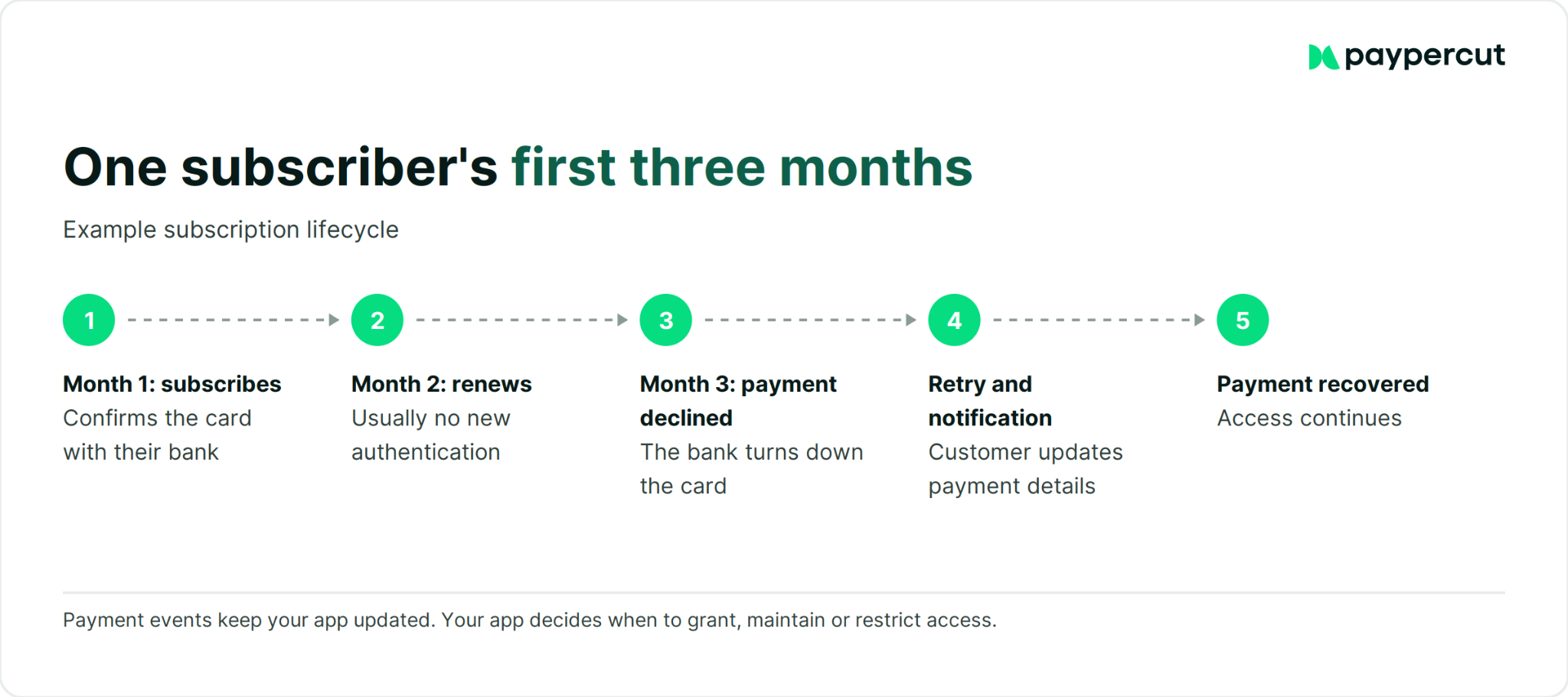
Most renewals don't require another manual payment. After the initial authorized payment, subsequent merchant-initiated charges may qualify to proceed without another Strong Customer Authentication step. However, a customer's bank can still decline a charge or require additional action.
Failed payments need a recovery process. Many subscription platforms retry declined charges and notify customers when they need to update their payment details. This is commonly called dunning.
Check how many retries are supported, when they happen and whether notifications are included or require configuration.
Your SaaS still controls customer access. When a renewal fails, you might offer a grace period before restricting the product. If someone cancels, you may allow them to continue using it until the end of their paid period.
The payment platform reports what happened, but your application applies the subscription rules.
More complex requirements, including seat-based pricing, plan upgrades with proration or a custom billing portal, may still require development even with hosted checkout.
How much will recurring billing cost?
Fees are easier to compare against an actual subscription base.
Imagine your SaaS has 200 subscribers paying RON 100 per month, all using EEA consumer cards. That's RON 20,000 in successful monthly renewals.
Based on published pricing, the illustrative monthly fees would be:
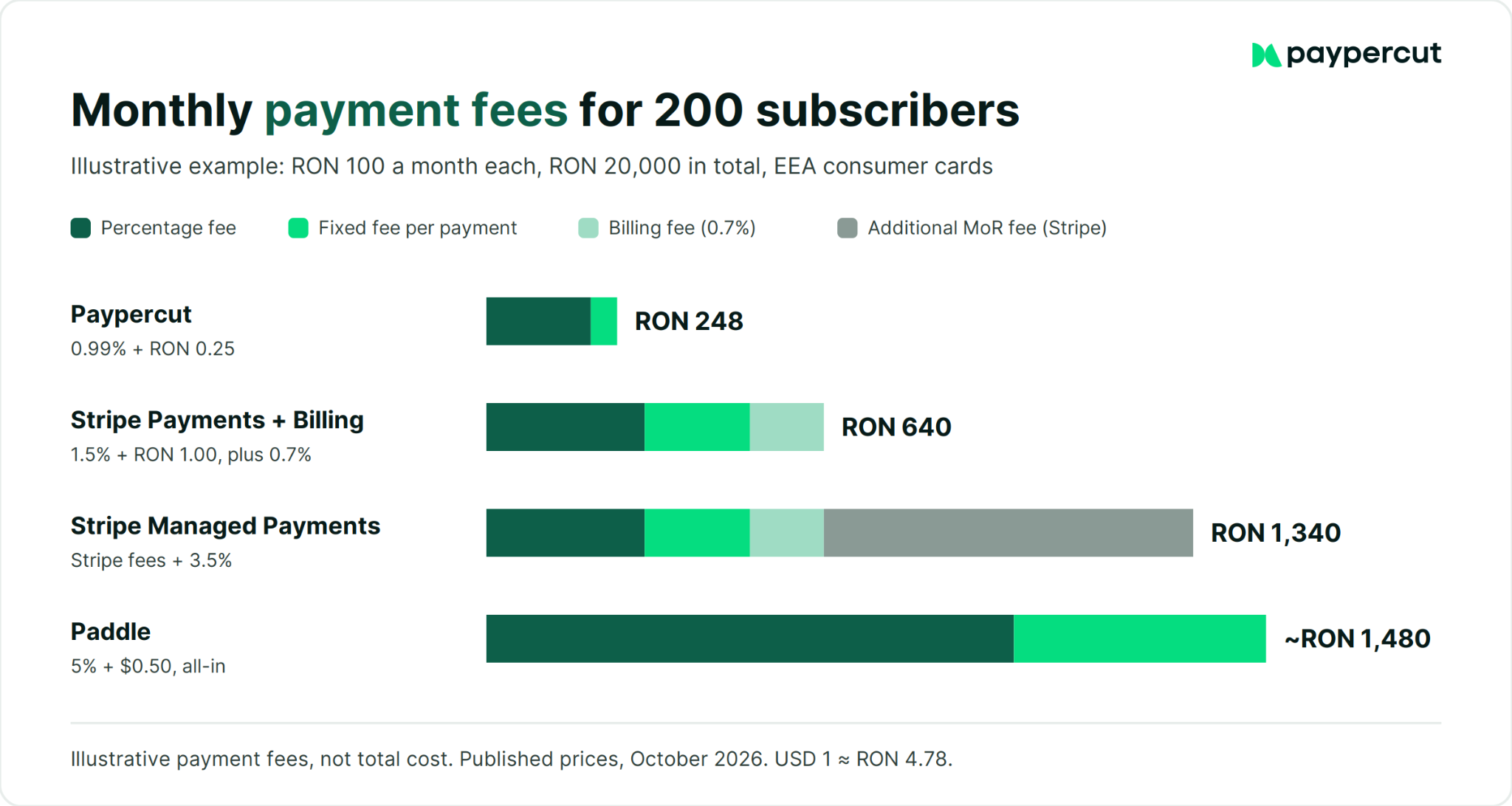
Illustrative payment fees, not total cost of ownership. Assumes RON 100 is the full amount charged in every case, EEA consumer cards where relevant, and USD 1 ≈ RON 4.78 (BNR reference rate, 7 October 2026). Stripe Managed Payments' additional fee applies to the relevant transaction amount, including VAT. Excludes other potential costs such as currency conversion, disputes, refunds and accounting. Actual fees depend on provider terms and transaction details.
The price difference is substantial, but the services aren't directly comparable.
A Merchant of Record takes on transaction VAT administration and other payment-related responsibilities. With a payment platform, your company retains responsibility for those activities and their associated costs.
Two factors can change the numbers further:
- Business cards: If your SaaS mainly serves companies, some subscribers may use commercial cards that carry higher processing fees.
- Lower-priced plans: Fixed fees make up a larger share of cheaper subscriptions. A RON 1.00 fixed fee is 1% of a RON 100 payment, but about 3.4% of a RON 29 payment before the percentage fee is added.
Run the comparison using your cheapest subscription tier and expected customer card mix, not just your headline price.
When Paypercut makes sense for Romanian SaaS
Whether your customers are in Romania, elsewhere in Europe, or both, you shouldn't need a different payment setup for every market you sell in.
Paypercut supports hosted subscription checkout and automatic recurring card payments. Your application creates the Checkout Session through the API, while your backend handles subscription and invoice events to keep customer access in sync.
You can accept payments in multiple currencies, including RON and EUR, receive payouts in your existing business bank account and pay 0.99% + RON 0.25 per transaction for eligible EEA consumer cards, without a separate subscription billing fee.
For SaaS companies with straightforward subscriptions, that means predictable payment costs, room to grow across European markets and less work managing payment collection, without building your own checkout.
Ready to simplify recurring payments?
Accept subscriptions from customers in Romania and beyond, without building your own checkout or adding complexity as your business grows.
FAQs
What's the fastest way to set up recurring payments without writing custom checkout code?
Hosted subscription checkout is often the simplest starting point. Some providers offer subscription payment links that can be created without code, while others, including Paypercut, document an API-based subscription checkout flow. You'll still need to connect subscription and payment events to customer accounts to manage access automatically.
Who handles EU VAT compliance if I use a Merchant of Record instead of a payment gateway?
A Merchant of Record handles applicable transaction VAT for the sales it makes as the seller. It calculates, collects and remits that tax and provides customer-facing billing documents as required. With a payment gateway or payment platform, your Romanian company generally remains the seller and retains responsibility for its VAT obligations.
Do I still need to manage VAT myself if I use Stripe Payment Links instead of a Merchant of Record?
Yes. Standard Stripe Payment Links don't transfer the merchant-of-record role to Stripe. Your company remains responsible for applicable VAT obligations, although Stripe Tax can help calculate taxes. Stripe Managed Payments is a separate Merchant of Record offering, with additional fees and eligibility requirements.
Are regional providers like NETOPIA Payments better suited to Romanian banking than global platforms?
They can be, especially if you collect mainly in RON and value local banking arrangements. However, recurring billing features and integration requirements vary by provider. NETOPIA supports recurring charges through certain integrations, while global platforms may offer more ready-made subscription tools. Compare settlement, fees, subscription capabilities and development requirements rather than provider location alone.
What's the trade-off between using a Merchant of Record and a local Romanian provider?
The main trade-off is administrative responsibility versus cost and control. A Merchant of Record takes on transaction VAT and other payment-related responsibilities for covered sales, usually at higher transaction fees. A local provider may offer lower fees and domestic banking advantages, but your company remains the seller and handles its own VAT, invoicing and customer relationships.