
On 1 January 2026, Bulgaria adopted the euro at a fixed rate of 1.95583 lev to the euro, becoming the euro area's 21st member. Overnight, a Sofia store selling to Athens stopped doing anything that looks like a foreign-currency sale, and a Sofia store selling to Bucharest still is.
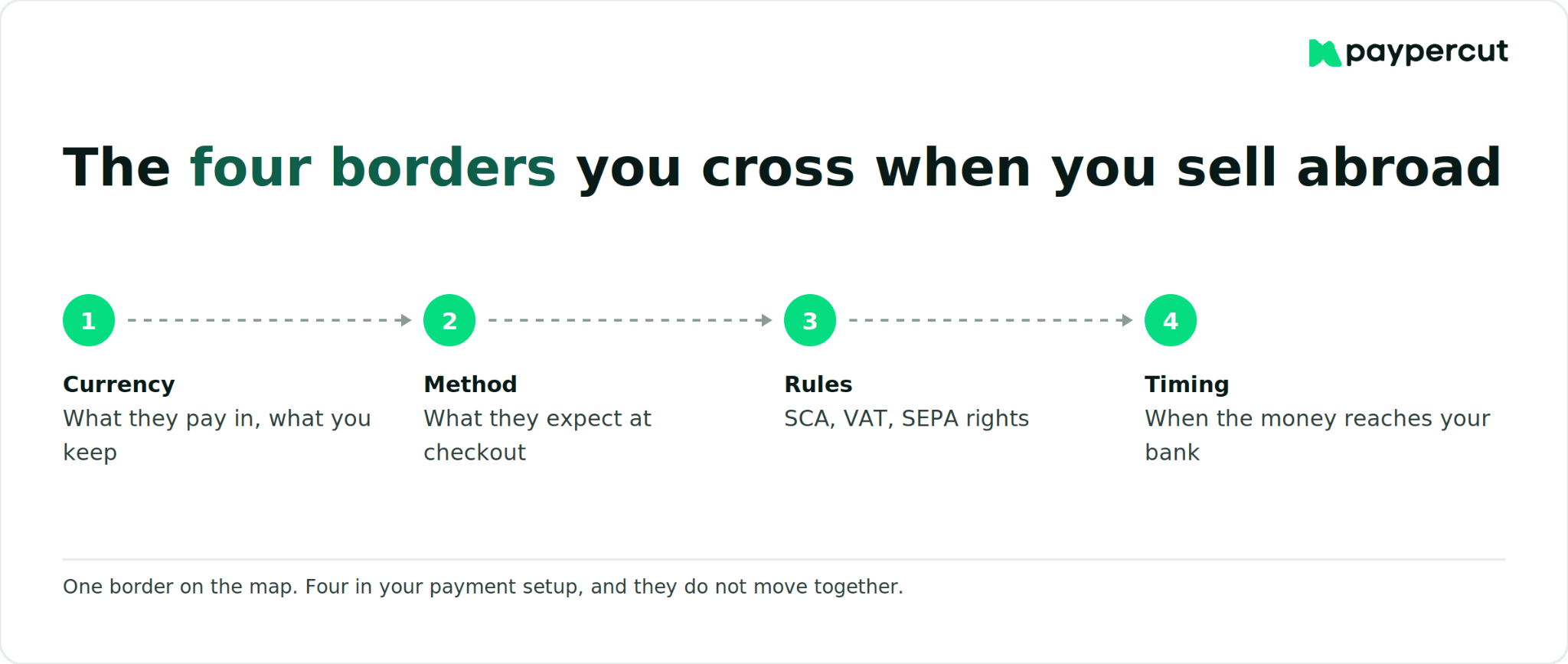
That is the useful thing to notice about international payments in this region. The border on the map is one line. The border in your payment setup is four different ones, and they do not move together.
Most merchants discover this in the wrong order. They ask "can I accept payments from Germany" and get a yes, because the answer is nearly always yes. Then they find out three months later what it cost them, which method they never offered, and why the money took a week.
Here is what actually changes, in the order it will reach you.
Key takeaways
- You almost certainly do not need a merchant account per country.
- Separate the currency your customer sees from the currency you keep.
- Ask for the FX margin as a number, not as "competitive rates."
- Local payment methods are where orders are lost, not where fees are.
- Destination-country VAT becomes relevant at 10,000 EUR, not at your first foreign order.
What changes when you start selling across borders
Accepting international payments from a CEE base means four separate things change, and only the first one is about price:
- Currency. What the customer is charged in, and what lands in your account.
- Method. What the customer expects to see at checkout in their own market.
- Rules. Authentication, VAT and the payment rights your customer already has.
- Timing. When the money reaches your bank, and how you reconcile it.
Your legal ability to sell into another EU market is rarely the constraint. The single market handles that. The cost, the conversion rate and the admin load are the constraints, and all three are decided by choices you make at setup.
Border one: the currency your customer pays in, and the one you keep
These are two decisions, and merchants routinely treat them as one.
What the customer sees is presentment. Showing a German buyer a price in EUR rather than RON or PLN removes a mental conversion step at the exact moment they are deciding. It is usually a checkout and catalogue configuration choice, though how it is implemented and priced varies by provider.
What you keep is settlement. This is where the money is. Ask three questions and insist on numbers:
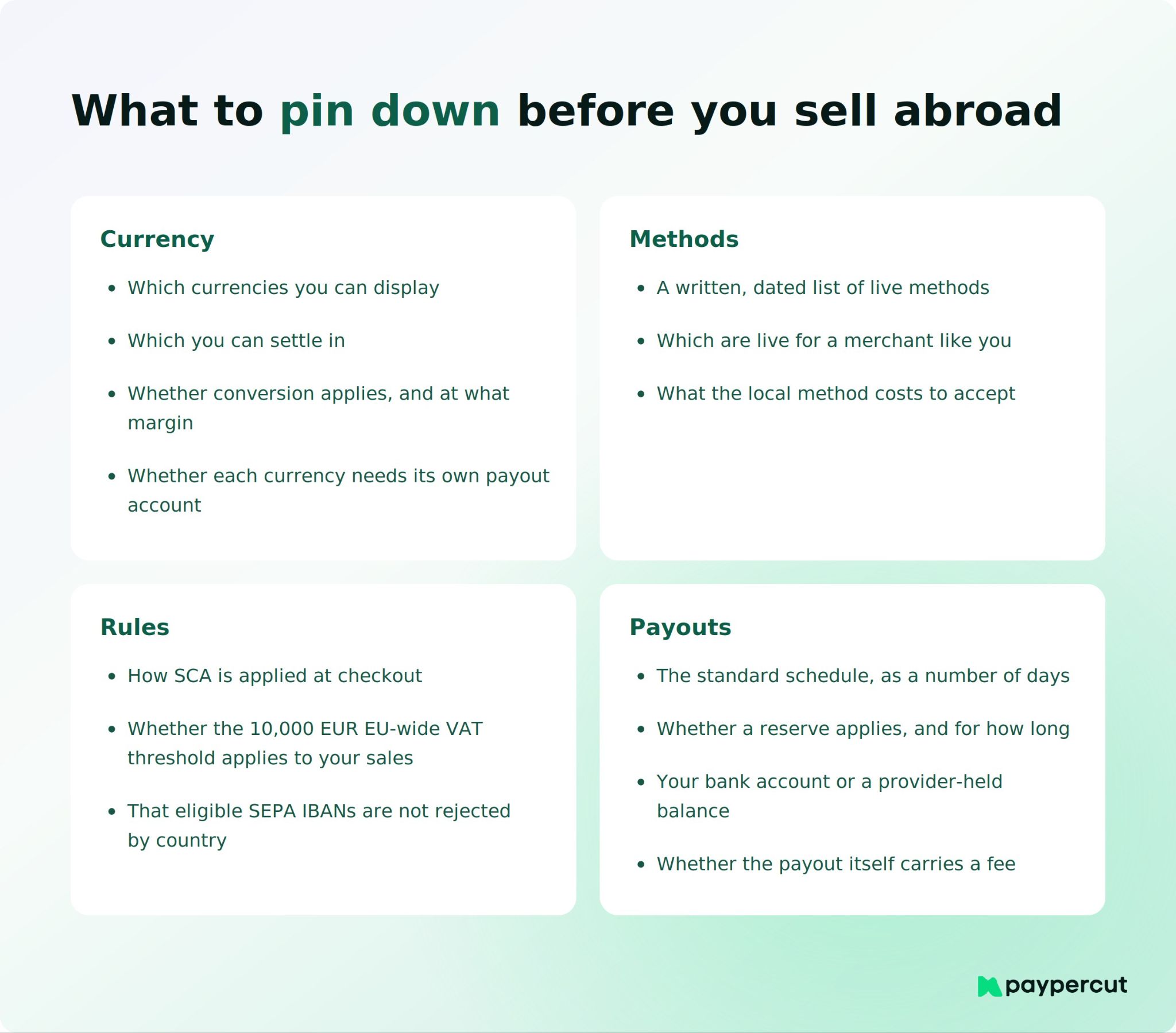
- Which currencies can you actually settle in, as a list?
- Does each settlement currency need its own arrangement, or does one cover several?
- What is the FX margin when a payment has to be converted?
On that last one, know what the rule covers. Regulation (EU) 2019/518 says that where a conversion is offered to the payer on a card payment, the charge must be shown as a percentage mark-up over the European Central Bank's reference rate.
That protects your customer at checkout. It says nothing about the margin your provider applies to your settlement.
So ask for that one separately, as a number. A provider that answers "competitive rates" is answering a question you did not ask.
There is a third possible answer: no conversion at all. Some providers settle each payment in the currency it was taken in, which removes the margin but means a payout account for every currency you want to keep.
Bulgaria's euro switch shows why the distinction matters. Euro sales into the euro area no longer convert. Sales priced in PLN, RON, HUF or CZK still might, depending on what you settle in.
The customer's country does not create FX exposure. The currency pairing does. For you, the practical rule is that "EU" and "euro" are not the same map.
Border two: what your customer expects to see at checkout
A fee difference costs you a percentage. A missing payment method costs you the order.
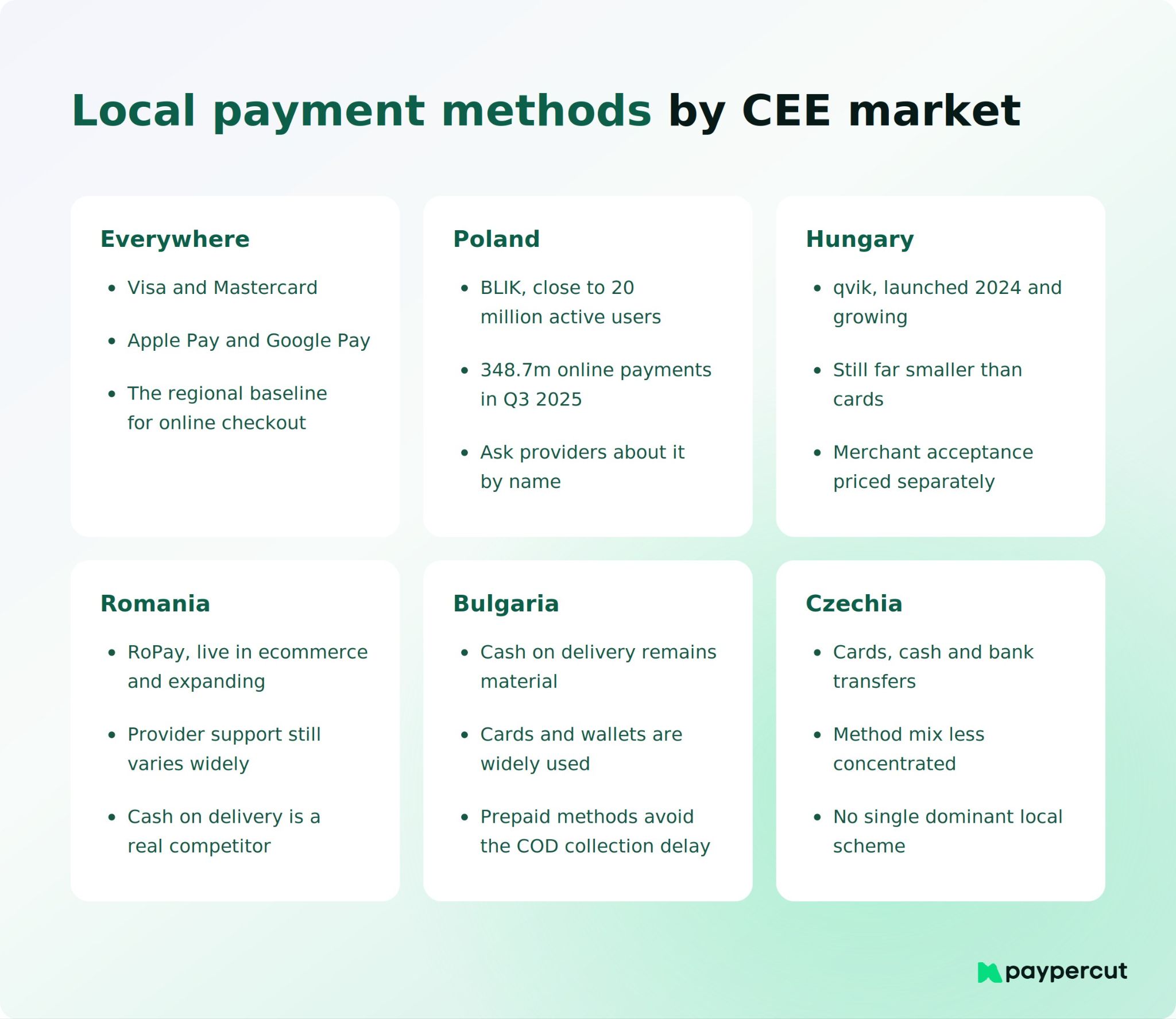
Cards and wallets are the regional baseline. Visa, Mastercard, Apple Pay and Google Pay will carry most of your cross-border volume, and no CEE market treats them as optional. Past that, each market has a habit of its own.
Poland. BLIK is not a nice-to-have. In the third quarter of 2025 alone, BLIK users completed 348.7 million online payments, up 21% year on year, against a base of close to 20 million active users. If you sell to Polish consumers, it belongs on the shortlist of methods you ask a provider about by name.
Hungary. qvik, the domestic instant-payment option launched in 2024, is still much smaller than cards but is spreading through 2025 and 2026. It is one of the local options to understand when comparing payment methods in Hungary, especially as merchant acceptance is priced separately, so instant does not automatically mean free.
Romania and Bulgaria. Cash on delivery is still a real competitor, not a legacy option. It pushes collection risk and cash-flow timing out to the moment of delivery, which is why a prepaid method that converts beats a small rate reduction.
Romania also has RoPay, the instant transfer scheme run by TRANSFOND and the banks. It is live in ecommerce and expanding through 2026, though provider support still varies widely.
Czechia. Cards, cash and bank transfer-based methods are all widely used, so the method mix is less concentrated than in Poland.
Two things follow.
Ask every provider for a written, dated list of the methods live for a merchant like you today, not the methods on the partner page. Several have been arriving in this region for years.
And do not localise every market at once. Add the local method for the market already producing orders, measure it, then move on.
Border three: the rules that follow your customer, not you
Three rules do most of the work here, and two of them are in your favour.
Strong customer authentication. Under PSD2, SCA generally applies to payer-initiated electronic payments from EEA customers, with defined exemptions and out-of-scope cases such as certain merchant-initiated transactions.
Every provider has to apply it where the rules require. What differs is how clumsy the 3-D Secure step feels, and a clumsy one loses you sales you never see. Those drop-offs are one of the main things to watch when increasing checkout conversion, especially on mobile and at the authentication step.
VAT on cross-border B2C sales. This is the one merchants underestimate. Since July 2021 there has been a single EU-wide threshold of 10,000 EUR:
- It covers intra-EU distance sales of goods plus telecoms, broadcasting and electronically supplied services, counted together
- Below it, subject to conditions, you can keep charging your home VAT rate
- Above it, destination-country rates apply, and the One Stop Shop lets you declare them in one return filed at home
- It is cumulative across the whole EU, not per country, and it does not cover every kind of service
Confirm your own position with your accountant, particularly if you store goods abroad.
IBAN discrimination. If you accept SEPA credit transfers or direct debits, you cannot require the customer's account to be held in a particular country. Article 9 of the SEPA Regulation (EU) 260/2012 prohibits it.
Some checkouts still do it anyway, through outdated validation rules. Test yours with a foreign IBAN before a customer does.
Instant euro transfers are becoming standard across Europe. Banks in the euro area have been required to receive instant payments since January 2025 and to let customers send them since October 2025.
Banks in the six EU countries outside the euro area, Poland, Hungary, Romania and Czechia among them, face 9 January 2027 to receive and 9 July 2027 to send. The direction of travel for account-to-account payments here is set.
Border four: when the money actually lands
Payment methods bring revenue in. Settlement decides when you can spend it, and adding a second country usually adds a second answer.
Pin down four things in writing:
- The standard payout schedule, as a number of days, and whether it differs by settlement currency
- Whether a reserve applies to your business type, and for how long
- Whether payouts go to the bank account you already have, or to a provider-held balance you then move yourself
- Whether the payout itself carries a fee, and whether that changes for a non-domestic currency
The balance model is not worse, just different. Some merchants like holding the float. Others find it an admin step nobody in the business owns.
Either way, reconciliation is the cost nobody quotes you. One market is one payout stream against one set of orders. Four markets can be four streams, four currencies and a spreadsheet somebody rebuilds every month.
Ask to see the transaction export before you sign, not after.
So do you need a provider in every country?
Almost never. There are three realistic routes, and the right one depends on how concentrated your foreign revenue is.
- One provider across markets. Best when no single foreign market dominates. One integration, one main provider relationship, simpler reconciliation. The trade-off is that a regional provider may not carry every hyper-local method on day one.
- A local provider per market. Worth it when one market is big enough to justify its own setup. The trade-off arrives as overhead: separate contracts, settlement, support queues, and a second integration to maintain.
- A default plus a specialist. A regional provider as the default, plus one local provider for the market where you need a method it does not carry. This can be the most practical answer for a CEE merchant with one large export market.
You do not have to switch in one move. Keep the incumbent live, route some traffic to the new provider, and compare the two on real transactions. Slower, but it settles the question with your own data instead of a sales deck.
If two options score close, choose whoever answered in plain numbers. A provider vague about FX margin or payout days before you sign rarely gets specific afterwards.
One setup that follows you across CEE
Plenty of global platforms work in this region. Fewer are built around how it actually pays, which is where Paypercut started. Against the four borders above:
- Currency. Payments are processed and settled in the same currency, with no conversion applied between the two, so there is no settlement FX margin to compare. A payout account may be required for each settlement currency you want to hold
- Method. Cards and wallets across supported markets, BLIK for Polish customers, and multiple BNPL providers through one integration, though each provider still approves merchants individually
- Pricing. Published by market, not quoted. Rest-of-EU pricing currently starts at 1.29% + EUR 0.10 for EEA consumer Visa and Mastercard and 2.69% + EUR 0.10 for all other cards. Local fixed fees differ by merchant market, so Polish merchants see PLN 0.25. BNPL is 5% per approved transaction where available
- What you do not pay. No activation fee, no monthly minimum, no PCI or gateway charge, no cross-border surcharge, and no additional fee to issue a refund, though the original transaction fee is not returned
- Payouts. Straight to the business bank account you already use, with no separate account to open
- Markets. One integration across supported European markets, so adding a country does not mean adding a provider
Disclaimer: Pricing, fees, product features and availability referenced in this article were checked on 18 September 2026 and may change over time. We recommend confirming the latest pricing and terms directly with each provider before making a decision.
Selling into more than one European market?
Register in a few minutes with fully digital onboarding, and test the full checkout in the sandbox while your verification runs.
Not sure which currencies you need? Talk to our team before you build, not after.
FAQs
Do I need a separate merchant account for each country I sell into?
In most cases, no. A single European payment setup can usually cover sales into multiple EU markets without a local entity in each one. Local tax registration, warehousing, regulated product categories and a provider's own eligibility rules can still create country-specific requirements, so check those separately. What can require separate arrangements is settlement currency, since each currency you want to hold usually needs its own settlement account. Ask a provider two things: which markets you can sell into on one integration, and which currencies you can settle in.
Which local payment methods should I support for customers in Central and Eastern Europe?
Cards and wallets are the baseline everywhere. Beyond that, support the method your largest foreign market actually uses: BLIK for Polish customers, qvik in Hungary, RoPay as it spreads in Romania, and bank transfer-based methods in Czechia. Cash on delivery remains common in Romania and Bulgaria, though it carries costs that prepaid methods do not. Add local methods one market at a time, starting with the market already producing orders.
Can I use SEPA to accept Euro payments as a CEE-based business?
Yes. SEPA covers euro credit transfers and direct debits across the SEPA area, and Article 9 of Regulation (EU) 260/2012 means you cannot require a customer's account to be held in a particular member state. Note that a credit transfer is a different acceptance experience from card checkout, because the customer initiates it. Direct Debit runs on a mandate you collect. Euro instant transfers are phasing in, with non-euro-area banks in scope from January 2027.
How do currency conversion fees affect international sales?
They apply whenever a payment is converted between the currency your customer pays in and the currency you settle in, charged as a margin on top of the underlying rate. Where a conversion is offered to your customer on a card payment, EU rules require it shown as a percentage mark-up over the ECB reference rate. Your own settlement FX is separate, so ask your provider to state that margin explicitly. Settling in the currency the customer paid in avoids conversion altogether.
How does payout speed change once I'm accepting payments from multiple countries?
The payout schedule may stay the same, but you can end up with more than one payout stream, one per settlement currency, each with its own timing and reconciliation. Ask whether the payout schedule differs by currency, whether a reserve applies, and whether money goes directly to your existing bank account or to a balance you have to move yourself. The admin cost of multiple streams is often larger than the timing difference.