

Barion may have worked perfectly well when you launched your store. But the payment setup you chose at the start doesn’t always stay the best fit as the business grows.
You may start selling to more customers outside Hungary, your average basket may change, or you may move to a different ecommerce platform. As order volume grows, things like payout costs, invoicing and reconciliation can also start to matter more than they did before.
At that point, it’s worth comparing what else is available and looking at the full setup, not just the headline transaction rate.
Key takeaways
- SimplePay, Stripe and Paypercut are three alternatives worth comparing with Barion.
- Barion’s Fix pricing depends on your basket size and card mix.
- Your platform and payment methods can narrow the choice quickly.
- Payouts, fixed fees and admin can change the real cost of getting paid.
When a Barion alternative starts making sense
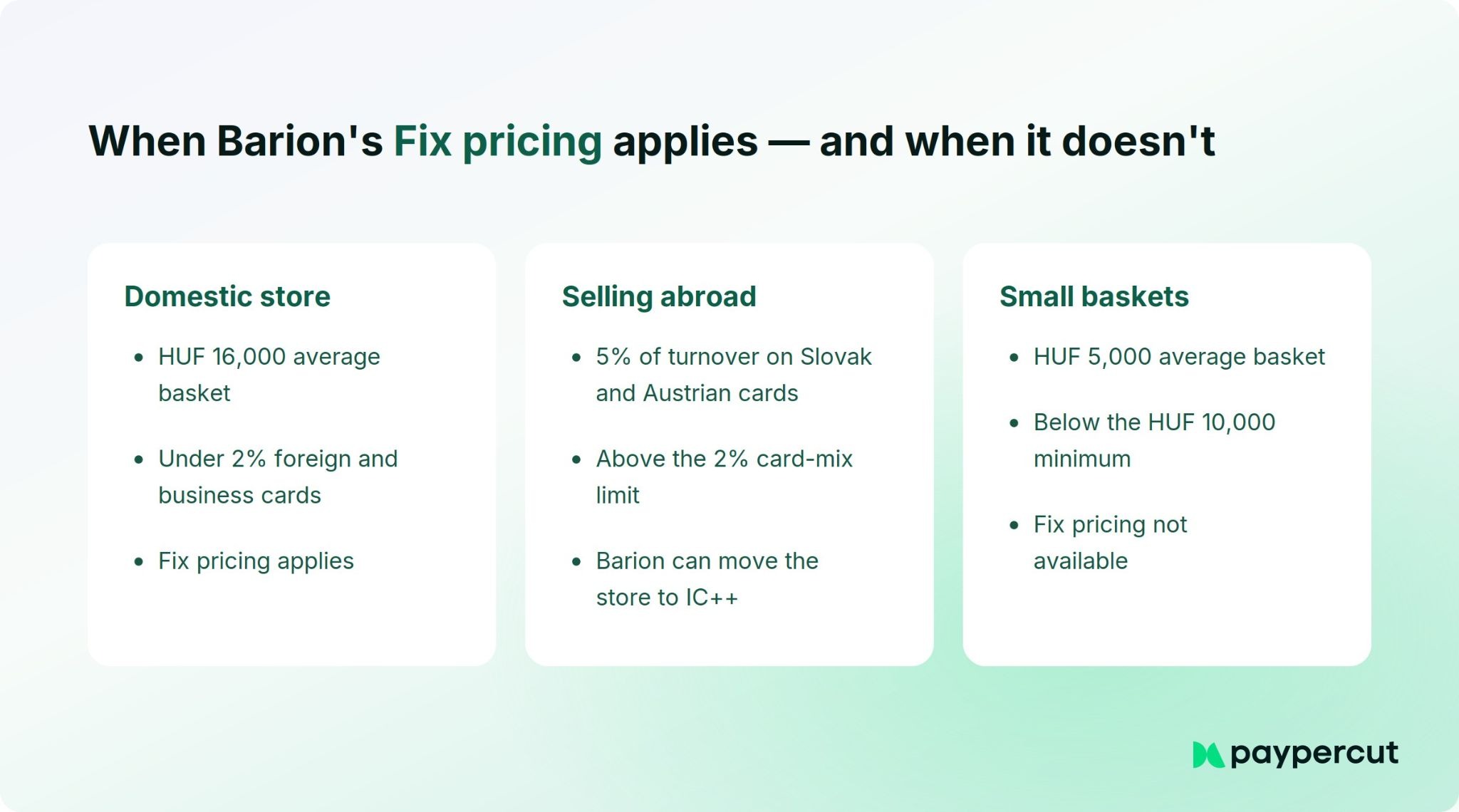
Barion’s Fix pricing is built around a fairly specific store profile. Two conditions matter in particular: your average basket and the share of foreign consumer and business cards in your turnover.
More of your customers pay with foreign or business cards. Under Barion’s Fix pricing, corporate cards and foreign consumer cards must together account for less than 2% of monthly card turnover to remain eligible for the package. If that share reaches 2% or more, Barion can move you to IC++ pricing, where the final fee varies depending on the card.
Your average basket falls below HUF 10,000. That is the other main Fix condition. If you sell lower-priced products, accessories or add-ons, the advertised Fix rates may no longer apply.
You’ve moved to Shopify. Barion’s Shopify integration is deprecated, with support for existing integrations having ended on 30 June 2026. For a Shopify merchant, that turns the comparison into a practical migration question rather than simply a pricing one.
The extras start to matter more. Card payments first land in a Barion balance. Moving HUF to a Hungarian bank account costs 0.10%, with a minimum HUF 70 fee, so it is worth including the payout step when you compare costs.
if Barion moves a merchant from Fix to IC++ because the Fix conditions were breached, the fee schedule does not allow that merchant to move back to Fix later.
Best Barion alternatives for your ecommerce store
*Pricing and product information checked in October 2026. Actual costs can vary by card type, merchant agreement, currency and additional services.
1. SimplePay
SimplePay is the most obvious local alternative to Barion.
If most of your customers are in Hungary, it gives you strong local platform coverage and access to payment methods that matter specifically in this market. That includes qvik, alongside cards, Apple Pay and Google Pay.
It is also built into platforms such as UNAS and Shoprenter and has a WooCommerce integration, which is useful if you want to change provider without changing the rest of your ecommerce setup.
The biggest difference is pricing. SimplePay does not give every online merchant one public card rate. Your offer includes a connection fee and transaction commission based on the merchant setup, so you need the actual quote before you can compare it properly.
SimplePay is worth looking at if: your business is still primarily Hungary-focused, qvik matters, and your platform already supports it.
Before you switch: ask for the full commercial offer, including the connection fee, transaction commission and settlement terms. Don’t compare it with Barion on one percentage alone.
2. Stripe
Stripe is the more developer-focused option.
Its Hungarian card pricing is public. Standard EEA cards currently cost 1.5% + HUF 85, premium EEA cards 2.8% + HUF 85, UK cards 2.5% + HUF 85, and other international cards 3.15% + HUF 85. Standard payouts are free.
That HUF 85 fixed fee is worth paying attention to. On a HUF 5,000 order, for example, the standard EEA card fee works out at about 3.2% of the order value.
Where Stripe becomes more interesting is flexibility. It supports a large international payment stack, APIs and additional products for things such as subscriptions and more complex payment flows.
Stripe is worth looking at if: you have developers involved, run a custom setup or sell well beyond Hungary and want access to a broader international payments ecosystem.
Before you switch: calculate what that fixed fee does at your real basket size, and include any additional Stripe products you plan to use in the comparison.
If Stripe is already on your shortlist, a direct Stripe vs Paypercut comparison can make the differences around pricing, integrations and payouts easier to see.
3. Paypercut
Paypercut becomes more interesting when your store is growing beyond a mostly domestic setup.
The published Hungarian pricing is 1.29% + HUF 25 for EEA consumer Visa and Mastercard cards and 2.69% + HUF 25 for EEA business Visa and Mastercard cards and Visa and Mastercard cards issued outside the EEA. There’s no monthly minimum or activation fee on the published plan.
The main difference compared with Barion is that those published rates aren’t tied to keeping your average basket above HUF 10,000 or foreign cards below a certain share.
That matters if more of your customers are coming from elsewhere in the EEA. An Austrian consumer Visa or Mastercard falls into the same published rate as a Hungarian consumer Visa or Mastercard.
The payout flow is also simpler. Instead of building up a balance with the payment provider and then withdrawing it, payouts go to the business bank account you already use.
For ecommerce, Paypercut supports hosted and embedded checkout along with integrations for platforms including WooCommerce, Shopify, OpenCart, Magento and PrestaShop.
Paypercut is worth looking at if: you’re growing across the EEA, want your card pricing to stay easier to forecast as your customer mix changes, and would rather have payouts go straight to your existing bank account.
Before you switch: Paypercut does not currently list UNAS or Shoprenter among its public plugins.
Start with the platform you already use
Before getting too deep into fees, check which providers your webshop can actually support.
- WooCommerce gives you the widest choice here. Barion, SimplePay, Stripe and Paypercut all have integration options.
- UNAS has its own built-in payment-provider list, which includes Barion, SimplePay and Stripe alongside local bank gateways.
- Shoprenter also has a defined set of supported integrations, including Barion and SimplePay, with additional options available through Shoprenter Pay.
- Shopify is a little different. Shopify Payments is now available in Hungary, and if you use a third-party payment provider, Shopify can also charge a third-party transaction fee depending on your plan.
If you’re already on UNAS or Shoprenter, it usually makes more sense to start with the providers your platform already supports than to move the whole store for a payment integration.
Check whether the provider offers a ready-made plugin, an API or a hosted checkout you can connect without rebuilding your store. If you’re on a custom or less common platform, that integration route may matter more than whether the provider appears on a pre-built list.
If you’re still weighing up different setups, it helps to compare payment gateways for online stores in Hungary by fees, settlement, local methods and integration options.
What will it actually cost you?
Once you know which providers work with your platform, look at the numbers using your own store.
The advertised rate is only part of the cost. What matters is how that pricing behaves with your average basket, monthly order volume, card mix and payout setup.
A fixed fee, for example, barely moves the needle on a HUF 30,000 order but matters much more on a HUF 5,000 one. With Barion, your basket size and the share of foreign or business cards also affect whether Fix pricing stays available.
SimplePay is harder to compare until you have an actual merchant quote. Stripe’s HUF 85 fixed fee makes basket size important. Paypercut’s published EEA consumer-card pricing is easier to forecast upfront because it isn’t tied to Barion-style basket or card-mix conditions.
pull three months of transactions before you ask for quotes. Your average basket, foreign-card share and business-card share will tell you far more than a headline rate.
Check the payment methods you’d be giving up
Price and platform fit aren’t much help if the new setup drops something your customers actually use.
For Hungarian stores, the obvious one to check is qvik. SimplePay supports it, so if qvik already brings in a meaningful share of your payments, that can narrow the shortlist quickly.
The same goes for Apple Pay, Google Pay, saved cards and recurring payments. Before switching, look at your current payment mix rather than comparing feature lists in isolation.
If hardly anyone uses a particular method, losing it may not matter. If a significant share does, it probably does.
Which methods matter most will depend on your customer base, but the most popular payment methods in Hungary give you a useful benchmark.
Think about what happens after the payment
The checkout is only one part of the setup.
Look at when the money reaches your bank, whether there is an extra payout or withdrawal fee and how easy it is to match payouts back to individual orders.
This is one of the clearer differences between Barion and Paypercut. With Barion, funds first sit in your Barion balance. With Paypercut, payouts go to the business bank account you already use.
For a smaller store, that distinction may not change much day to day. As volume grows, fewer steps between payment and reconciliation can make the operation easier to manage.
The same applies to invoicing. If you use Billingo, Számlázz.hu or another invoicing tool, check that paid orders still trigger the right workflow and that refunds can be traced back cleanly.
how often are payouts sent, where do they land, and is there any fee before the money reaches your bank?
Which Barion alternative makes sense for you?
By this point, the shortlist should be fairly clear.
- SimplePay is the strongest fit if you’re still focused mainly on Hungary and local payment methods such as qvik are important to you.
- Stripe makes more sense if you have developers involved, run a custom setup or need a broader international payments stack.
- Paypercut is particularly relevant if your store is growing across the EEA and you want card pricing that is easier to forecast as your customer mix changes, with payouts going directly to your existing business bank account.
And if Barion still works well for your platform, customer mix and day-to-day operations, there is no need to switch just because alternatives exist.
The point is to solve something: a pricing model that no longer fits, a platform limitation, an awkward payout flow or a setup that has become harder to manage as the store grows.
How to switch without disrupting checkout
Once you’ve chosen a provider, don’t rush to remove Barion.
Set up the new payment option first and test the full flow: successful and failed payments, refunds, invoice creation and the way payouts appear in your accounts.
run a failed payment, refund and mobile wallet payment too. Most checkout issues show up outside the first successful card transaction.
If you use saved cards or recurring payments, check what happens to existing payment credentials before you move customers over. These don’t always transfer automatically between providers.
Where your platform allows it, keeping both payment options live during testing gives you room to catch problems before the old setup disappears.
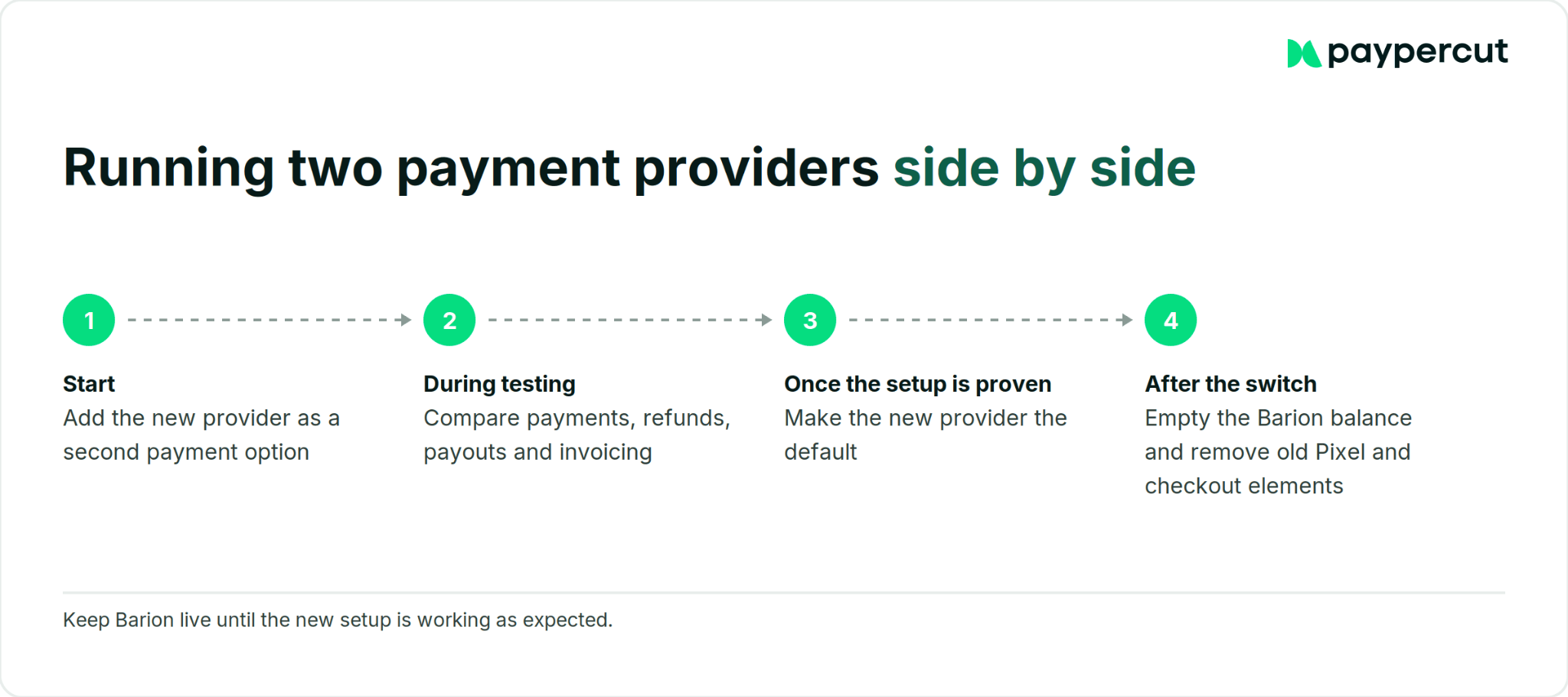
Once everything is working, remove any Barion-specific checkout elements, scripts and references that are no longer needed.
Ready to see if Paypercut fits your store?
If you’re moving beyond a mostly domestic setup and want simpler EEA pricing with payouts to the business bank account you already use, Paypercut is worth comparing with Barion.
FAQs
How does Barion compare to SimplePay for a Hungarian online store?
Both are familiar to Hungarian shoppers and built into WooCommerce, UNAS and Shoprenter. The main difference is pricing: Barion publishes conditional Fix rates and charges to withdraw your balance, while SimplePay prices by individual quote with a one-time connection fee. SimplePay also offers qvik for webshops.
Does the alternative integrate with WooCommerce or UNAS?
On WooCommerce, you can choose freely: Barion, SimplePay, Stripe and Paypercut all offer plugins. UNAS builds selected providers into the platform, including SimplePay, Stripe, PayPal and the bank gateways, so you choose from that list. Paypercut's published plugins don't include UNAS.
Do Barion alternatives support automated NAV-compliant invoicing?
Invoices are normally issued by your invoicing app, such as Számlázz.hu or Billingo, which reports them to NAV Online Számla. Your webshop usually triggers the invoice when an order is marked as paid, so the provider's job is to send that paid status back reliably.
How do fees compare between Barion and other Hungarian payment providers?
It depends on your basket size and card mix. Barion's Fix rates have no fixed fee but depend on monthly conditions. Stripe adds HUF 85 per payment and Paypercut HUF 25, which matters most on small baskets. SimplePay quotes individually, so ask for every fee in writing.
Is switching away from Barion complicated for an established online store?
On a supported platform, the technical step is usually a plugin and new credentials. Test saved-card and recurring flows, payment-status mapping and invoicing before changing the default, and run the new provider alongside Barion until you're confident.