
A merchant account and a payment gateway aren't direct alternatives. A payment gateway handles payment information at checkout, while a merchant account is part of the acquiring setup behind accepting card payments.
UK businesses don't always need to arrange a merchant account separately, though. Payment providers can bring the gateway and acquiring setup together in one service.
So the merchant account vs payment gateway question is really about how your UK payment setup is arranged, and who manages each part of it.
It also explains why the advice can sound contradictory. An ecommerce plugin may say you can take cards today. A bank may say you need to apply for a merchant account first. Each is describing a different way of arranging the same payment flow.
Key takeaways
- A payment gateway and a merchant account do different jobs.
- A bundled provider can combine the gateway and acquiring setup in one service.
- Compare the total cost, not the headline rate.
- Check onboarding, settlement and restriction terms before you sign.
Merchant account vs payment gateway: what each one does
The payment gateway handles the checkout side
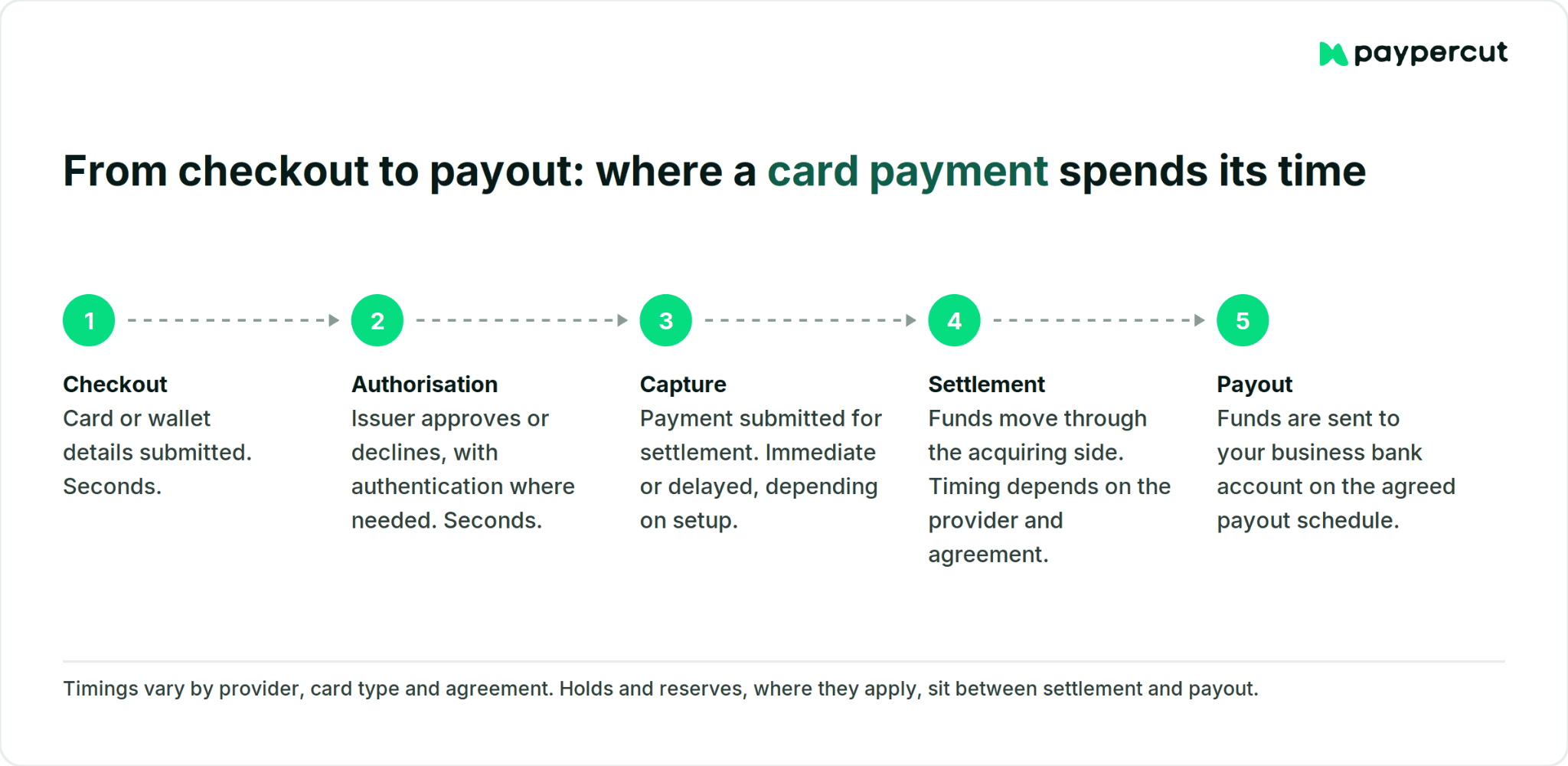
A payment gateway securely captures and transfers payment information from the checkout into the payment-processing flow for authorisation. The checkout itself may be hosted by the provider, embedded in your site or connected through an ecommerce plugin.
A hosted checkout can reduce how much cardholder data touches your systems and therefore reduce PCI DSS scope, depending on the integration. An embedded checkout gives you more control over how the payment experience looks and feels.
Wallet buttons such as Apple Pay and Google Pay sit at this layer too, and 65% of UK adults were registered for a mobile wallet in 2025.
The gateway also shapes the checkout steps where customers drop off, so it affects conversion as well as cost.
The merchant account sits on the acquiring side
A merchant account is part of the acquiring arrangement that enables your business to accept card payments and have them settled. It's set up with an acquirer, the bank or licensed firm that works with Visa and Mastercard on the merchant's side of a payment.
If you arrange one directly, you’d typically get your own merchant ID (MID) and a direct contract with the acquirer. Settled funds are paid to your business bank account on an agreed schedule.
The acquirer assesses the financial and operational risk of supporting your card payments, including potential refunds and disputes. That's why the application usually asks detailed questions about your business.
Both functions exist in the wider payment flow. What varies is whether you arrange them separately or get them through one provider.
The three setups UK businesses choose between
UK providers package the gateway and the acquiring side in three common ways.
Dedicated merchant account with a separate gateway
You apply to an acquirer for your own MID, then connect a gateway from a different company.
This gives you the most room to negotiate. Keeping the gateway separate can also give you more flexibility to change the checkout technology without replacing the acquiring relationship.
In return, you manage two contracts, two sets of fees and two support desks. If a payment fails, you may need to work out which side the problem sits on.
UK banks may ask you to open separate merchant accounts for different sales channels, such as one for online orders and one for face-to-face sales.
Merchant account and gateway from the same provider
Many UK acquirers offer an online gateway alongside the merchant account. You still apply and go through underwriting, but you sign one contract and deal with one supplier.
Pricing is usually quoted once you've applied rather than published in advance.
A bundled payment provider
Here the provider brings the gateway and the acquiring side together as part of one service. That means fewer separate contracts, integrations and provider relationships for the merchant to manage.
In many cases you won't have a MID of your own, and quotes may describe the arrangement as a payment service provider rather than a gateway.
Not every bundled provider uses the same acquiring model. Ask how yours is set up and who makes decisions about your account.
Applications are usually online, and some providers let you start setting up your integration or testing in a sandbox while checks continue. Verification and risk checks still apply, both during onboarding and once you're trading.
What each setup costs a UK online store
A dedicated merchant account often comes with several separate charges:
- a merchant service charge on each payment
- gateway fees, charged monthly, per transaction or both
- in some cases, a PCI compliance fee, a minimum monthly charge or a setup fee
- an early termination fee if you leave mid-contract
These quotes are hard to compare. In its card-acquiring review, the PSR found that acquirers don't typically publish their prices, and that many small merchants don't shop around even when a better deal is available.
Bundled providers more often publish their rates. For a UK business, though, the rate usually depends on where the customer's card was issued.
Where the customer's card comes from
After Brexit, the previous EU interchange caps stopped applying to EEA-issued cards used for online purchases at UK businesses. Interchange on EEA consumer cards used at UK businesses rose from 0.2% to 1.15% for debit and from 0.3% to 1.5% for credit.
In January 2026 the High Court upheld the PSR's power to cap these fees. As of September 2026, the remedy is still being developed and no cap is in force.
As an illustrative example, Stripe's published UK standard pricing, checked September 2026, is 1.5% + 20p for standard UK cards and 2.5% + 20p for EEA cards, plus 2% where currency conversion applies. Other providers price differently.
On those rates, a store taking 800 orders a month at £50 each, or £40,000 in card sales, would pay:
- £760 if every customer used a standard UK card
- £840 if one order in five came on an EEA card
- £1,000 if those EEA customers also paid in euros
In this example, the combination of EEA cards and currency conversion increased the monthly bill from £760 to £1,000.
Choosing a dedicated merchant account doesn't make the underlying interchange cost disappear, although how it appears in your pricing depends on your agreement.
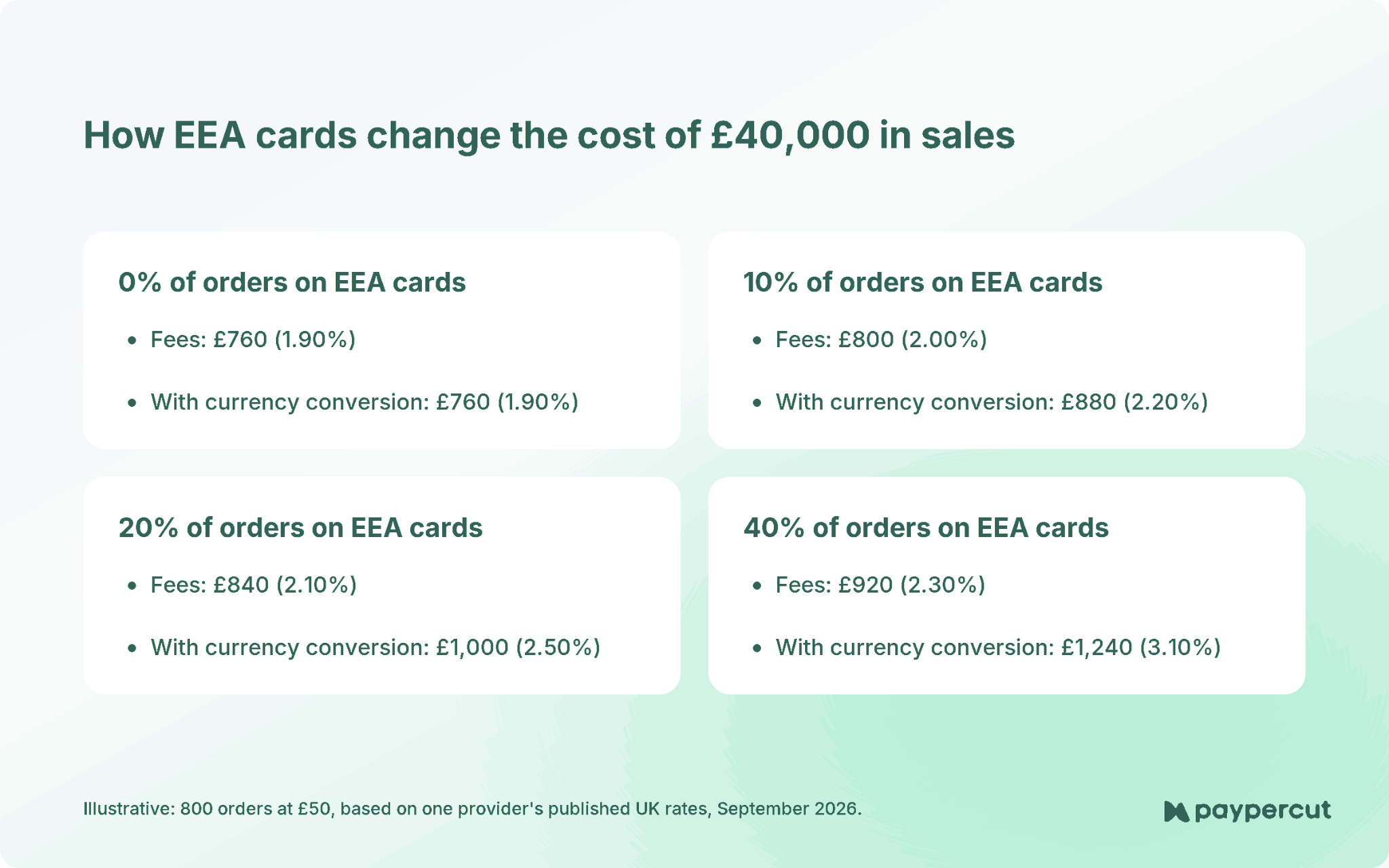
*Pricing checked September 2026. Rates vary by merchant country, customer location, card type, business model and negotiated agreement.
Whichever setup you choose, also ask about chargeback fees, refund charges, payout fees and exit costs.
How long does it take to get approved for a merchant account in the UK?
A dedicated merchant account can take time to set up. UK government-backed business guidance gives a typical timeframe of one to four weeks, with start-ups potentially taking longer. You may also be asked for additional information such as a business plan and cashflow forecasts.
Expect questions about:
- what you sell and how long delivery takes
- your refund policy
- your expected monthly volume
- who owns and runs the business
Delivery time gets particular attention. If customers pay weeks before their order arrives, the acquirer is exposed to more potential disputes.
A bundled provider typically runs its application online, and some let you start setting up online card payments and testing in a sandbox while checks continue. The checks themselves don't disappear, and a provider can ask for more information once you're trading.
What happens to your payments if an account is frozen or terminated?
Depending on the provider and reason for the review, several things can happen:
- A payout hold. Some or all payouts are paused while specific transactions are reviewed.
- A reserve. Part of your payouts is held back for a period to cover possible disputes. It can be set at approval or introduced later.
- Restrictions. Limits on volumes, products or payment types, or a pause on new transactions.
- Termination. The account is closed. Funds from past sales may still be held for a period, because customers can dispute payments after the sale.
If an acquirer terminates an account for certain reasons, such as excessive chargebacks or fraud, it can add the business to Mastercard's MATCH database.
Acquirers check MATCH for merchants terminated in the past five years when assessing new applications, so a listing can make approval elsewhere harder.
Common triggers include:
- a sudden jump in volume
- pre-orders with long delivery times
- a rising chargeback rate
- a website that doesn't match what you declared when you applied
- products the provider restricts
Both dedicated and bundled arrangements can involve initial checks and ongoing monitoring. What differs is who makes decisions about your account and what your contract says about notice and how reviews are handled.
Before you sign, ask in writing whether a reserve can apply to your business, what triggers a payout hold, and how much notice you'll get before an account is restricted.
Clear delivery and refund terms, accurate business information and prompt responses to disputes can also reduce avoidable account reviews. Settlement and exit terms are among the trust signals worth checking in any payment provider.
Which should you choose?
On its own, a payment gateway can't replace the acquiring side, because it only handles payment information. A bundled provider can cover both, so you may not need to arrange a merchant account yourself.
A bundled payment provider may suit you if you:
- want one provider to handle more of your payment setup
- run on Shopify, WooCommerce or another ecommerce platform and want a ready-made integration
- prefer to see transaction pricing upfront rather than request a quote
- don't need to negotiate your acquiring and gateway arrangements separately
A dedicated merchant account may suit you if you:
- have high, steady card volume and want to negotiate your acquiring rates directly
- work in a sector bundled providers restrict or decline
- run a custom checkout and want to choose the gateway separately
- need settlement arrangements a bundled provider doesn't offer
Your payment setup can change with your business. As your sales volume, customer markets or payment requirements evolve, it's worth checking whether your current setup still gives you the right balance of cost, control and convenience.
Bringing more of your payment setup together
If a bundled setup makes more sense for your UK business, Paypercut brings more of the online payment setup into one platform, so you don't have to manage a separate gateway, checkout and multiple payment tools.
With Paypercut, you can:
- Give customers more ways to pay, with cards and digital wallets through hosted or embedded checkout
- Sell across markets, accepting payments in multiple supported currencies, including GBP
- Connect the way that works for your store, using ecommerce plugins or an API
- See transaction pricing upfront, with published rates rather than having to request a quote
- Keep using your existing business bank account for payouts, instead of opening a new account with Paypercut
See how Paypercut works
Explore the demo to see how the checkout works in practice, or talk to the team about your UK payment setup.
FAQs
Do I need a merchant account if I already use a payment gateway?
A gateway handles payment information, so card payments also need an acquiring arrangement behind it. With a standalone gateway, you usually need your own merchant account with an acquirer. With a bundled payment provider, the acquiring side is included in the service, so check your contract to see which arrangement you have.
Is it cheaper to set up a merchant account or use a payment gateway provider instead?
It depends on your volume, card mix and agreement. Bundled providers often publish transaction pricing upfront, while a dedicated merchant account may give higher-volume businesses more room to negotiate their acquiring rates. Compare the total cost across UK, EEA and international cards, including gateway, monthly and compliance fees.
How long does it take to get approved for a merchant account in the UK?
It typically takes one to four weeks, according to NI Business Info. Start-ups can take longer, and banks may ask for additional information such as a business plan and cashflow forecasts. Bundled providers usually run applications online, but they still carry out checks before and after you start trading.
Can a payment gateway fully replace a merchant account for a small online business?
A gateway on its own can't replace the acquiring side because it only handles payment information. A bundled payment provider can include both the gateway and acquiring arrangement in its service, so you may not need to arrange a separate merchant account yourself. A dedicated account may still be worth considering for high volumes, restricted sectors or more specific payment requirements.
What happens to my payments if a merchant account gets frozen or terminated?
It depends on the provider and the reason. Payouts may be held, funds may be kept in reserve, or the account may be restricted or closed while money from past sales remains held to cover potential disputes. For certain termination reasons, including excessive chargebacks or fraud, the business can be added to Mastercard's MATCH database, which acquirers check for terminations recorded in the past five years.