
There are many good reasons to expand your business into Hungary.
Its central European location makes it easy to reach both Western and Eastern markets, while low operating costs and a skilled workforce make it attractive for companies opening a local presence.
At the same time, international e-commerce businesses can benefit from a fast-growing market, with 82% of the country’s 9.5 million people shopping online.
But to make this expansion smooth and sustainable, you need to be aware of Hungary’s ongoing shift toward modern payments. While cash is still present, EU-aligned reforms have opened access to a full spectrum of digital financial tools and services.
To help you navigate this evolving landscape, this guide covers the top six payment methods in Hungary and gives you the context and practical insights you need to accept each one with ease.
Key takeaways
- Hungary uses the forint, but supports easy European transfers
Customers expect to pay in Hungarian forint, which helps build trust and improve conversion. At the same time, SEPA makes it easy to move euro funds across Europe. - Digital payments are growing, but multiple options are still essential
Electronic payments now account for 42% of transactions, and card usage is rising fast. However, cash, bank transfers, wallets, and Buy Now, Pay Later (BNPL) all remain important depending on the customer and use case. - Instant transfers, wallets, and QR payments are driving modernization
Real-time bank transfers, widespread digital wallet use, and new QR payment systems like qvik are making payments faster, easier, and more mobile-friendly. - Strong EU regulations make payments secure and reliable
Rules like PSD2 and GDPR ensure secure transactions and customer protection. Businesses must stay compliant, but benefit from a trusted and stable payment environment. - The right payment partner makes expansion much easier
Supporting local methods, currencies, and compliance can be complex. Platforms like Paypercut simplify this by providing all key Hungarian payment methods and local settlement through one integration.
4 key facts about the Hungarian payments market
The most popular payment methods in Hungary make more sense when you understand the local context. With this in mind, here’s a quick overview of the Hungarian payments market.
1. The official currency in Hungary is the Hungarian forint
Although Hungary is part of the EU, payments are made in Hungarian forint (HUF), not euros. This means your prices, checkout, and settlements will usually be in forint when selling to Hungarian customers.
However, Hungary is part of the Single Euro Payments Area (SEPA), a European payment system that standardizes euro bank transfers across participating countries, which makes euro bank transfers across Europe simple and predictable. This allows international businesses to move funds easily, even when accepting payments in forint.
2. Hungary is fully integrated into the European financial system
Hungary’s payment system is regulated by the Hungarian National Bank (Magyar Nemzeti Bank, or MNB), which oversees banks and payment providers and ensures transactions are secure and reliable.
The country is also part of the European System of Central Banks, meaning its financial infrastructure follows EU-wide rules and standards.
One example is PSD2, a European regulation that strengthens payment security by requiring strong customer authentication for online transactions.
For businesses, this creates a trusted and predictable environment, making it easier to accept payments securely and operate across European markets.
3. Cash is still widely used, but electronic payments are rapidly growing
Cash remains common in Hungary, especially for small, in-person purchases and certain everyday services. However, electronic payments are becoming increasingly popular across the economy.
In 2024, 42% of all payment transactions in Hungary were electronic, showing a clear upward trend in digital payment adoption.
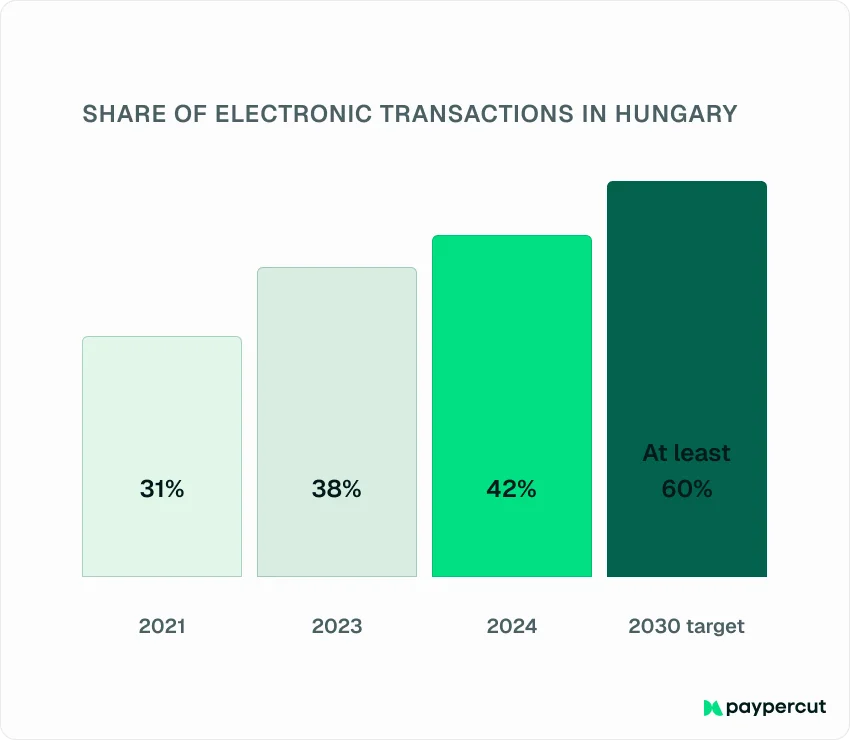
Customers are also increasingly favoring electronic payments, with as many 61% of the population considering electronic methods safer than cash.
4. The government is actively encouraging the shift toward electronic payments
Hungary’s government and central bank are actively promoting the use of electronic payments to modernize the economy and improve efficiency. Since 2021, online retailers have been required to offer electronic payment options, making digital payments a standard part of e-commerce.
The central bank is also working closely with banks and payment providers to expand access to digital payment services and increase adoption, which has so far led to:
- Increased use of electronic payments, even for small everyday purchases
- Electronic payments becoming the primary payment option for a growing numbers of businesses
- Rapid adoption of innovative payment solutions, such as instant and mobile payments
- Improved awareness and understanding of digital payment methods
- Extended access to access to bank accounts and digital payments, including among 78% of older adults
The 6 main payment methods in Hungary
To succeed in Hungary, it’s essential to offer the payment methods customers already know and trust.
Here are the six most common payment methods in Hungary and why each one matters.
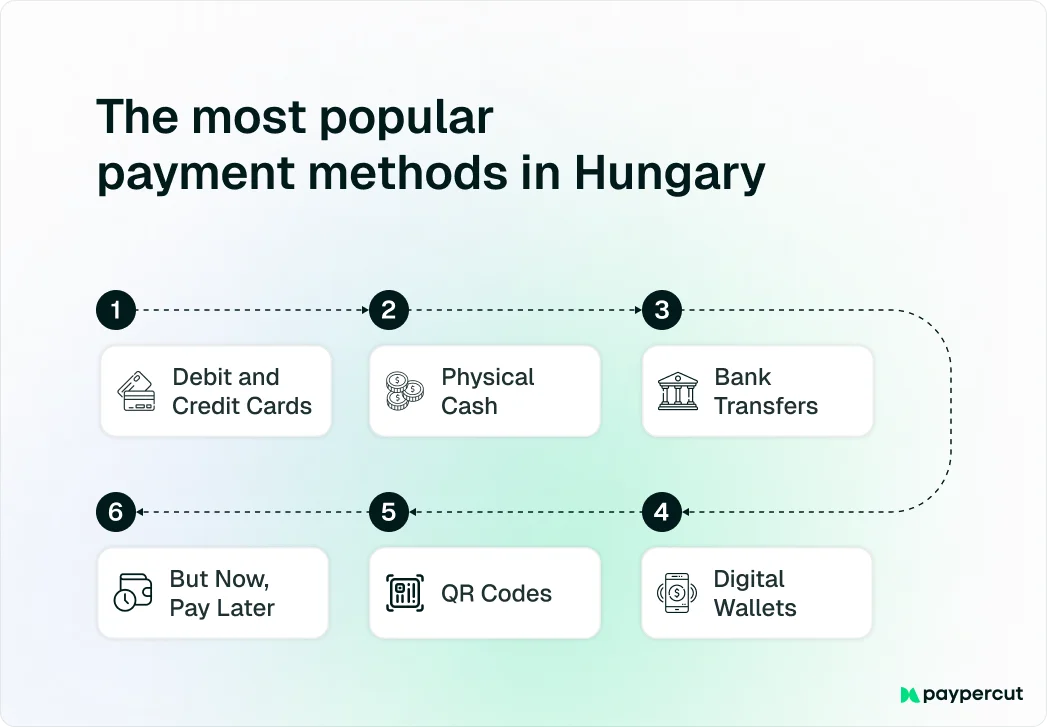
1. Debit and credit cards
While cash historically dominated everyday transactions in Hungary, the rise of e-commerce and contactless payments has made debit and credit cards one of the most commonly used payment methods today.
MNB’s 2025 Payment Systems Report clearly shows this shift:
- There were nearly 2 billion card purchases in Hungary in 2024, a 10% increase compared to 2023.
- Card payments reached a total value of almost €53 million.
- The number of foreign online card payments increased by 25%.
- The number of merchants accepting online card payments increased by 18%.
In total, there are nearly 9.5 million payment cards in Hungary. This translates to an average of 1.16 cards per adult, which is below the European Union average of 2.1 cards per adult.
When it comes to the cards themselves, debit cards are more common than credit cards, as most consumers use cards linked directly to their bank accounts.
Visa and Mastercard are the dominant card networks, and there is no local card scheme.
2. Physical cash
Cash use in Hungary is gradually decreasing, reflecting the steady shift toward electronic payment methods.
In 2024, the number of cash withdrawals fell by 4%, while their total value dropped by nearly €1.6 billion (4.5%).
However, cash payments are still far from disappearing, as shown by the following insights fro\
the 2025 Payment Systems Report:
- For physical retail transactions, 57% of payments are still cash.
- Cash is especially dominant for small purchases under €13.
- Transactions between private individuals (P2P) and payments from individuals to businesses for various services continue to be predominantly cash-based.
In addition, Cash on Delivery (COD) remains a common e-commerce delivery option, allowing customers to pay in cash when receiving their order.
3. Bank transfers
Bank transfers are a popular payment method in Hungary, especially for e-commerce, bill payments, and larger purchases.
Their popularity has grown significantly since the launch of Hungary’s instant payment system in 2020, which allows transfers to be completed within seconds.
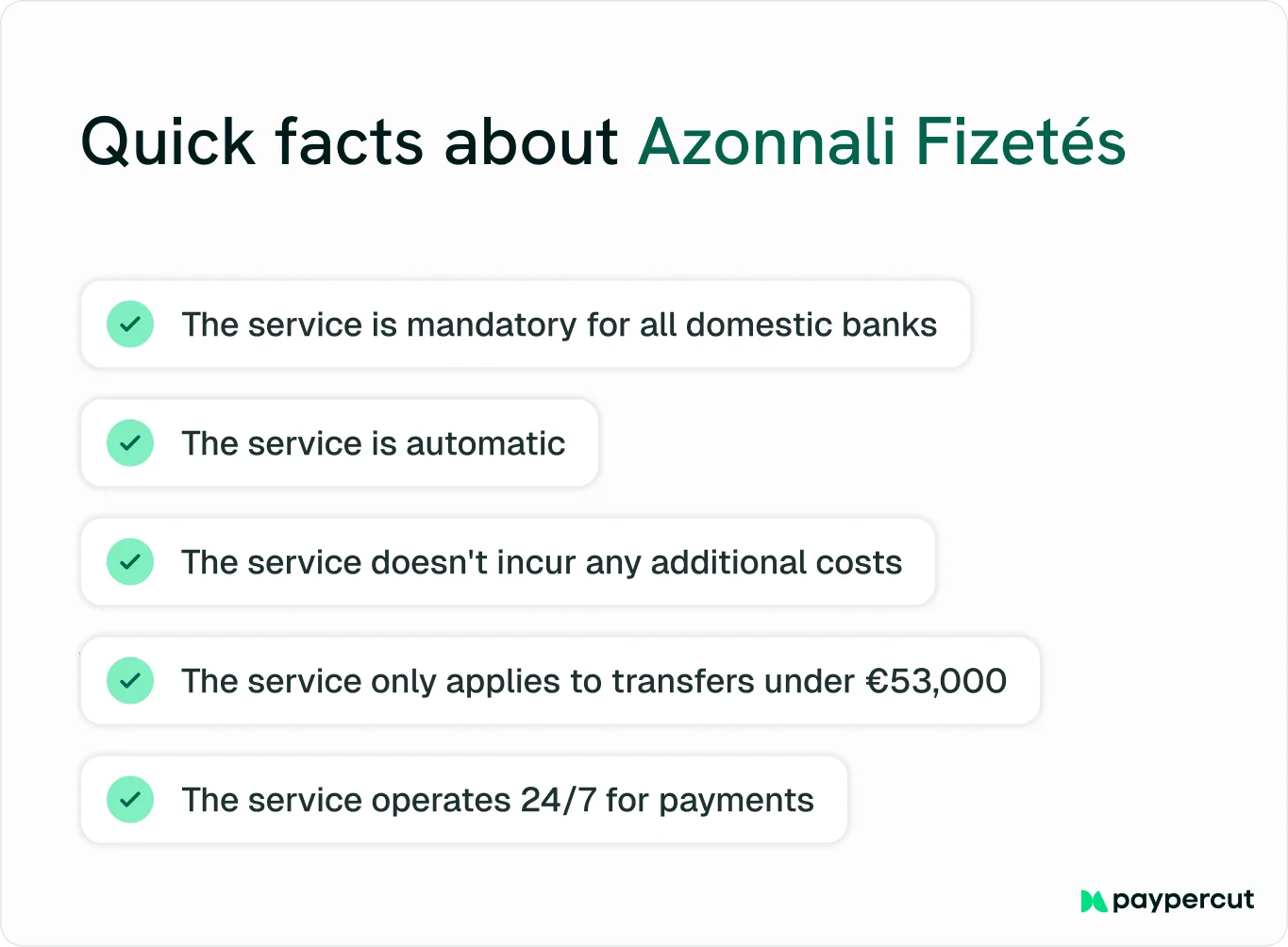
This system, known locally as Azonnali Fizetés, enables customers to send money instantly 24/7, using a bank account number, phone number, or email address.
All Hungarian banks are required to support instant payments, making the system widely accessible and reliable.
4. Digital wallets
Hungarian customers are increasingly adopting innovative payment methods, with digital wallets leading the charge.
One-quarter of all bank cards in Hungary are already registered in a mobile wallet, and more than one-quarter of card purchases are made using these wallets.
The increasing popularity of digital wallets in Hungary makes sense, as they allow customers to pay quickly and securely using their smartphones without needing to enter card details manually. These details are stored safely and not shared directly with merchants, which makes digital wallets a trusted and convenient payment option for both online and in-store purchases.
Apple Pay and Google Pay have played a major role in this adoption by making secure payments more seamless, which has helped make them a top choice for mobile and online payments in Hungary.
5. QR codes
QR code payments, powered by Hungary’s qvik system, are one of the clearest signs of the country’s push toward modern, instant payments.
Launched in 2024 by the MNB, qvik allows customers to pay instantly by scanning a QR code with their banking app, with funds transferred directly from their account to the business within seconds.
This system is designed to be faster and more cost-effective than traditional card payments, while remaining free for consumers. It also works across major Hungarian banking apps, making it widely accessible without requiring additional wallets or cards.
These benefits, paired with the efforts of the MNB to actively expand merchant acceptance, resulted in more than 400,000 QR code payments concluded by April 2025, with around one-third of the Hungarian population becoming familiar with these services.
6. Buy Now, Pay Later
In Hungary, Buy Now, Pay Later (BNPL) is particularly popular among younger digital shoppers and for higher-value purchases, where customers prefer to spread out the cost.
Several local and international providers operate in Hungary, including Cofidis, SimplePay, and Klarna, while in the B2B space, providers like PastPay allow businesses to delay payments and manage cash flow better.
Until recently, many of these services operated outside traditional consumer credit regulations, especially for short-term, interest-free payments.
However, new rules adopted in 2025 will bring most BNPL providers under formal consumer credit regulations starting in November 2026.
For businesses, this means BNPL will become more standardized and transparent, with clearer rules for providers and stronger consumer protections.
While this may introduce more structure behind the scenes, it also increases trust in BNPL services and helps ensure they remain a reliable and sustainable payment option for e-commerce.
4 best practices for accepting payments in Hungary
The following best practices will help you build a smooth, compliant, and future-ready payment experience for your Hungarian customers.
1. Adapt to local payment preferences
When expanding into Hungary, it’s important to support the payment methods your customers already use on a regular basis.
At a minimum, your business should support:
- Debit and credit cards, especially Visa and Mastercard
- Instant bank transfers
- Digital wallets, particularly Apple Pay and Google Pay
Since the MNB is also focusing on expanding innovative services beyond tech-savvy users, businesses that support modern options early can gain a competitive advantage.
That’s why you should also consider offering BNPL and QR code payments to meet evolving customer expectations and stay ahead of the market.
2. Offer payments in Hungarian forint
Since Hungary uses the forint rather than the euro, displaying prices and accepting payments in the local currency helps build trust and reduces friction at checkout.
Customers are more likely to complete purchases when they don’t have to worry about exchange rates or unexpected fees.
3. Stay compliant with local and EU regulations
The table below outlines the key regulations your business should be aware of when operating in the Hungarian market:
4. Partner with a versatile payment provider
The easiest way to support local payment methods and stay compliant is to work with a reliable payment provider like Paypercut that already integrates with Hungarian banks, local payment systems, and popular international payment methods.
This partnership can help you accept cards, bank transfers, digital wallets, and BNPL through a single integration, simplifying your expansion into the market.
Expand into Hungary with Paypercut
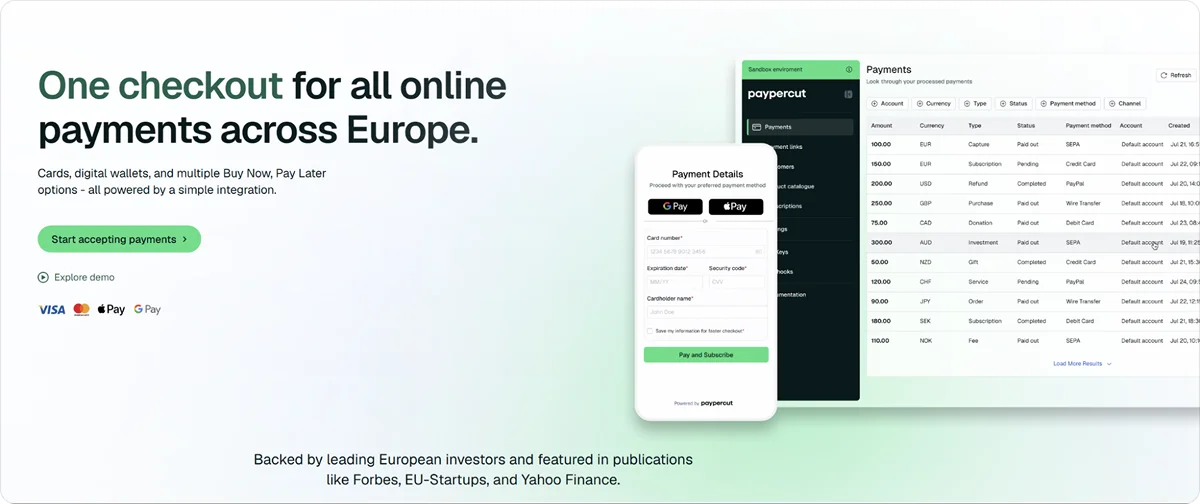
Instead of managing multiple providers, contracts, and integrations, Paypercut gives you a single, localized payment layer that adapts to the Hungarian market, including currencies, regulations, and customer preferences.
Here’s what Paypercut brings to the table:
- All payment methods in one integration: Accept cards, digital wallets, instant transfers, QR codes, and multiple BNPL providers through a single platform to simplify your setup and maximize payment acceptance.
- Multi-currency settlement with local payouts: Accept and settle payments in both forints and euros to reduce FX friction and manage cross-border revenue more efficiently.
- Smooth checkout experience: Deliver fast, mobile-optimized checkout flows to improve conversion rates and reduce drop-offs.
- Security and compliance handled for you: Process payments through an EU-regulated, PCI-DSS compliant infrastructure to stay secure and compliant without additional operational burden.
- Fast and simple integration: Launch quickly with ready-made plugins or flexible APIs to start accepting payments without heavy development work.
- Human-first support: Get direct help from payment experts to resolve issues faster and scale with confidence.
Thanks to this well-thought-out set of features, Paypercut helps you expand into Hungary and beyond without rebuilding your payment stack. You can onboard fully online, go live in hours, and start accepting payments immediately.
Sign up now to do just that, or talk to our team first to find the best setup for your business.