
If you are on Viva.com and wondering what else is out there, the honest answer is that the headline card rate is rarely what makes merchants move.
What moves them is where the money lands, which local methods and instalments they can offer, and what happens to the setup when they start selling outside Greece.
Here is how the alternatives compare on those three things.
Key takeaways
- Compare total cost, not just the headline transaction rate.
- Check whether payouts land with the provider or in your existing bank account.
- Alternatives include Revolut Business, myPOS, Worldline, Everypay, Paypercut, Stripe, Mollie and Adyen across three operating models.
- Confirm Greek card instalment support before switching providers.
The Viva wallet alternatives, grouped by model
Platforms with a built-in account work the way Viva.com does: acceptance, a balance, an IBAN and a card in one product. The trade-off is another account to reconcile if you keep your existing bank as your main one. Plan and transfer fees vary, so price them individually.
Greek banks and local acquirers are the longstanding route. Worldline Greece offers e-shops up to 48 interest-free instalments and dynamic currency conversion for non-euro cardholders, and Everypay is licensed by the Bank of Greece, states it serves more than 700 merchants, and offers its acquiring white-label to the local banking ecosystem.
The local payment mix also matters here, because Greek shoppers still expect a combination of payment methods. What varies inside this group is onboarding time, whether pricing is quoted rather than published, and how much self-service you get.
European platforms pay out to a bank account you already use. The provider may still hold an internal settlement balance, but you do not necessarily need to run a separate day-to-day account and move funds out of it yourself.
They typically offer some mix of hosted or embedded checkout, APIs and plugins, while payment expectations across Europe are increasingly shaped by wallets, instant payments and embedded checkout.
What to compare beyond the fee
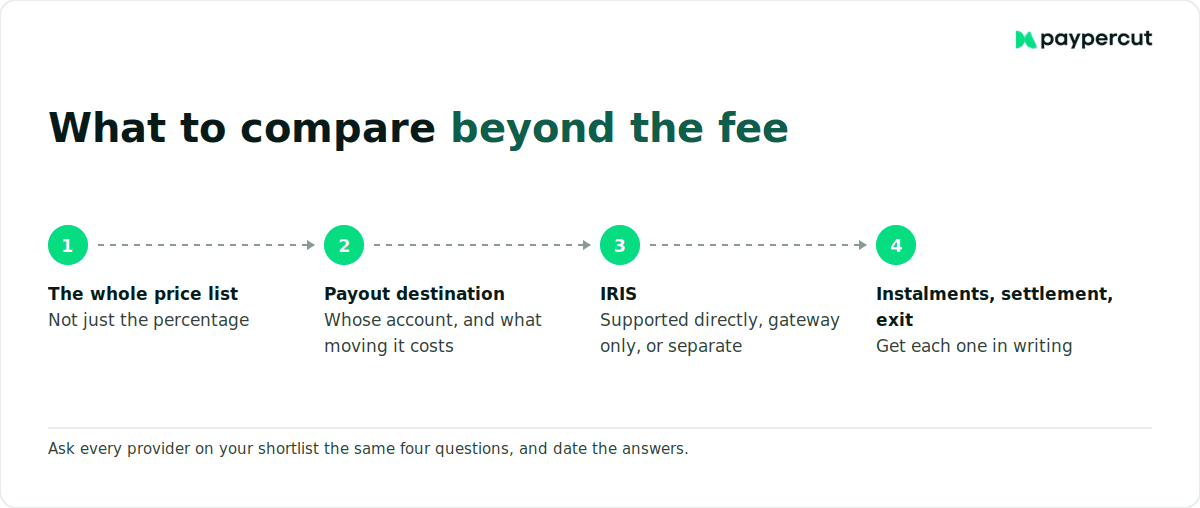
1. The whole price list, not the percentage
Viva.com's published pricing puts online domestic and EEA consumer cards at 2.19% + €0.24, with commercial, UK and international cards on an Interchange++ basis and an extra 0.40% where the card is issued outside the EEA. Underneath that sit the lines that decide the monthly total:
- 0.35% surcharge that may apply on certain official e-commerce plugins
- €0.03 per 3-D Secure authentication attempt
- Refunds at the payment acceptance fees plus €0.30, cancellations free
- €20 per lost dispute
- E-commerce plans from a Zero tier at €0.00 with a €4.99 minimum monthly charge, up to €19.99 a month
- Support tiers priced separately: AI chat free, human chat €4.99 a month, chat, call and video €19.99 a month
None of that is hidden, and publishing it is more than several alternatives manage. But for a plugin-based store on a paid support tier, the all-in cost is not just 2.19% + €0.24.
What to do: take last month's order count, average basket, refund rate and share of foreign and corporate cards, and price them against every provider's full list. A provider that will not run those numbers with you has told you something.
Take last month's order count, average basket, refund rate and share of foreign and corporate cards, and price them against every provider's full list. A provider that will not run those numbers with you has told you something.
2. Where the money lands, and what it costs to move
With Viva.com, settlement is real-time into your Viva.com account. Moving it onward is a separate priced action: outgoing SEPA transfers are listed at €0.80 with a limited number included per plan, and a Greek IBAN with unlimited free incoming transfers carries a €10.00 monthly fee, or no monthly fee with a charge per incoming transfer.
Some merchants prefer it that way. Instant access to funds is a real advantage and the business card against the balance is useful.
Others find it adds a step nobody owns: a balance to watch, a transfer to trigger, a second account to reconcile. It is a structural choice, so decide it rather than inherit it.
3. IRIS
Since 1 December 2025, acceptance of account-to-account instant payment services such as IRIS has been mandatory for B2C transactions in Greece. DIAS reports IRIS Commerce volumes up 70.8% year on year in 2025, with acceptance across roughly 1.2 million POS terminals and 70,000 e-shops.
Integration arrangements differ, so ask exactly how IRIS is provided: does the platform support it directly, act as the technical gateway while you contract with a Greek IRIS-acquiring bank, or require you to run IRIS separately.
Greek B2C merchants still need an IRIS-compatible arrangement alongside Paypercut where required.
4. Instalments, settlement days and the exit
Three quick ones, and the same three for every provider on your shortlist.
- Instalments. Which Greek cards, how many instalments, priced how. A yes with the detail attached, not a yes. This is the single most Greece-specific item on the list, and it is not a given.
- Settlement. Two numbers and one destination: how many days, whether the payout carries a fee, and whether money goes to your bank or a balance you move yourself.
- Exit. Minimum term, termination fee, and full transaction history export. Ask on the way in.
Is it worth leaving Viva.com at all?
Sometimes not, and that is worth saying plainly.
Viva.com Group includes Vivabank, a credit institution licensed and supervised by the Bank of Greece, and J.P. Morgan holds a minority stake in the group. It publishes its rates openly. It covers cards, IRIS, Klarna, wallets, payment links and in-person payments in one place, with real-time settlement into the Viva.com account, a Greek IBAN and a business debit card.
For a store selling only in Greece that wants one provider for online and in-person and is comfortable running part of its banking inside the platform, switching may not repay the effort.
Common reasons to move are payouts to your existing bank, different instalment needs, or expansion beyond Greece.
Switching without breaking your checkout
The technical work can be relatively small. The contractual and operational parts are where you need to be more careful.
On a supported e-commerce platform, adding a second provider may be as simple as installing and configuring a plugin. Custom checkouts, subscriptions and stored payment methods can require more developer work, so check the full order and reconciliation flow before estimating the migration.
That includes the payment experience itself, because small checkout friction points can quickly turn into conversion drop-off.
The low-risk sequence is the same either way:
- Integrate the new provider and run test transactions in its sandbox while your verification is still in progress
- Keep the existing provider live in parallel and route a share of real traffic to the new one, if your stack supports multiple providers or routing
- Compare the two on your own transactions, not on a sales deck
- Switch the default once the new flow is proven, and export your full history before closing anything
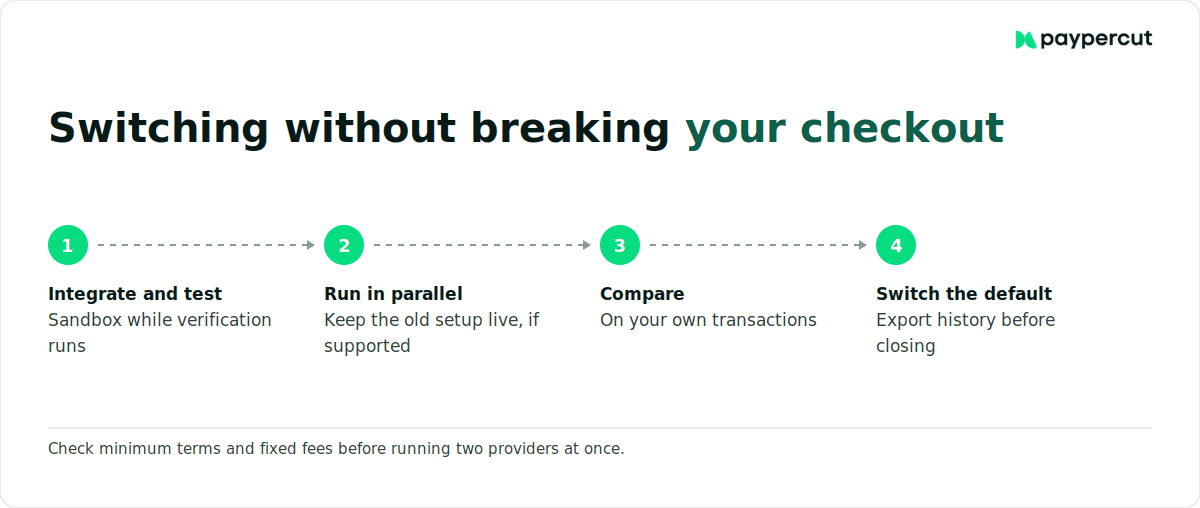
A staged cutover reduces the risk of finding a checkout or reconciliation problem after the old setup is already gone. Check minimum terms and fixed fees first, because running two providers in parallel can still carry costs.
Which Viva Wallet alternative fits which Greek store
You sell only in Greece, mostly small baskets, and want one provider for web and counter. Stay where you are, or compare providers in the built-in-account group that support both channels in Greece.
Instalments carry your higher baskets. Start with the Greek banks and local acquirers. Greek banks and local acquirers have the clearest documented support for δόσεις on Greek cards today.
You are already shipping abroad, or you will be within the year. Start with the European platforms. Pick for how the setup behaves in market two and three, because rebuilding a checkout for each new country is the expensive version of this decision.
You are a developer-led store with an unusual flow. Compare Stripe and Adyen on documentation and ecosystem, and accept that Greece-specific depth will need checking item by item.
If two options score close, take the one that answered in plain numbers. A quote you can model against your own last month is worth more than a range.
Where Paypercut fits among the alternatives
Paypercut is built for Greek stores that want payments to stay simple as the business expands beyond Greece.
Instead of opening another day-to-day account with your payment provider, payouts go to the business bank account you already use. And instead of rebuilding your payment setup market by market, you can use the same checkout across supported European markets.
- Published pricing. 1.29% + €0.10 on EEA consumer Visa and Mastercard, and 2.69% + €0.10 on EEA business Visa and Mastercard and non-EEA Visa and Mastercard. Apple Pay and Google Pay follow the same card pricing.
- Fewer fees around the transaction. No activation fee, monthly minimum or subscription, support charge, PCI or compliance fee, monthly gateway fee or cross-border surcharge. Refunds carry no additional fee, although the original transaction fee is not returned.
- Payouts to your existing bank. Payment revenue goes to the business bank account you already use, without another day-to-day account to open and move money out of.
- One setup across markets. Use the same online checkout across supported European markets, with local currencies and local settlement available in selected markets.
- BNPL through one integration. Add multiple BNPL providers through one setup, where available and subject to provider approval, at 5% per approved transaction, all-inclusive, with the merchant paid upfront.
If interest-free instalments on Greek cards are central to your sales, confirm current support before switching.
Disclaimer: Pricing, fees, product features and availability referenced in this article were checked on 18 September 2026 and may change over time. We recommend confirming the latest pricing and terms directly with each provider before making a decision.
Set up payments that follow you into your next market
Register online with fully digital onboarding, and build in the sandbox while your verification goes through.
FAQs
What should I compare between Viva Wallet and other payment providers in Greece?
Compare the full price list rather than the headline rate, then compare the operating model. Add up plan fees, plugin surcharges, 3-D Secure charges, refund and chargeback costs and any transfer fees against your own last month. Then ask where settlement lands, how IRIS is handled, whether instalments on Greek cards are supported, and what happens to the setup if you start selling outside Greece.
Is switching away from Viva Wallet complicated for an existing online store?
The technical work can be small. On a supported e-commerce platform it can mean installing and configuring a plugin; custom checkouts, subscriptions and stored payment methods need more developer time. Most disruption comes from contract terms, so check minimum term, early termination fees and data export before you commit. The low-risk route is to run both providers in parallel for a short period, then switch the default once the new flow is proven.
Do alternative payment providers support the same local Greek payment methods as Viva Wallet?
Not automatically, and this is the main thing to verify. Cards are the baseline; wallet support such as Apple Pay and Google Pay still needs checking by provider and integration. IRIS acceptance is required for B2C sales in Greece, and integration arrangements differ, so ask each provider whether it supports IRIS directly, acts as the gateway while you contract with a Greek IRIS-acquiring bank, or leaves you to run it separately. Interest-free instalments on Greek cards vary most of all, and are clearest with Greek bank and local acquirers.
How do fees typically compare between Viva Wallet and other providers?
Viva.com publishes its rates, which makes comparison possible: online domestic and EEA consumer cards are priced at 2.19% + €0.24, with commercial and non-EEA cards on an Interchange++ basis. Bank acquirers usually quote individually, so you often cannot model them from public pricing alone. Some European platforms publish standard card rates publicly, while others quote by merchant profile. Compare all-in cost per average order, not percentages.
What should I check about settlement speed when comparing Viva Wallet alternatives?
Ask for the standard schedule as a number of days, in writing. Then ask two follow-ups: does the payout itself carry a fee, and does the money go to your own business bank account or to a balance you have to transfer yourself. The destination matters as much as the speed, because a provider-held balance adds a reconciliation step that a direct payout does not.