
You launch in Poland with one payment provider. It works, the store takes payments, and nobody has much reason to think about it again.
Then Czechia gets added.
There’s a new currency to deal with, someone asks whether the checkout needs changing, and finance wants to know how the payouts are going to work. Maybe your current provider covers everything. Maybe it doesn’t, so you add another one.
A few months later, Germany comes up.
If you've got to the point where every new country starts another payments conversation, it may be time to look at the setup as a whole.
These are five of the tell-tale signs that a multi-market payment provider in Poland may make more sense than continuing to add to what you already have.
Key takeaways
- If every new market needs another payment setup, your current one may be getting harder to scale.
- BLIK still matters when Poland is one of several markets you sell in.
- Multiple providers can create extra work for finance, engineering and support.
- FX, settlement and payout costs belong in the comparison alongside the card rate.
- If you're still focused almost entirely on Poland, there may be no reason to switch yet.
What does a multi-market payment provider actually change?
At its simplest, a multi-market provider gives you a payment setup you can keep using as the business enters more countries.
That doesn't necessarily mean one identical checkout everywhere. It shouldn't. Customers in Poland don't suddenly stop expecting familiar payment options because you've opened a German store.
The benefit is mostly behind the scenes. Rather than choosing and integrating a new provider every time you add a market, more of the work can stay inside an existing setup: currencies, payment methods, settlement arrangements and the checkout itself, depending on what the provider supports.
There's also nothing inherently wrong with using several providers. Bigger merchants often do it deliberately. The problem is when the number keeps growing without anyone ever deciding that a multi-provider setup is actually what the business wants.
1. Foreign sales aren't accidental anymore
A few orders from Germany don't mean you need to redesign your payments stack.
A German version of the site is different.
So is a Czech campaign with its own budget, local pricing and somebody internally responsible for whether it works.
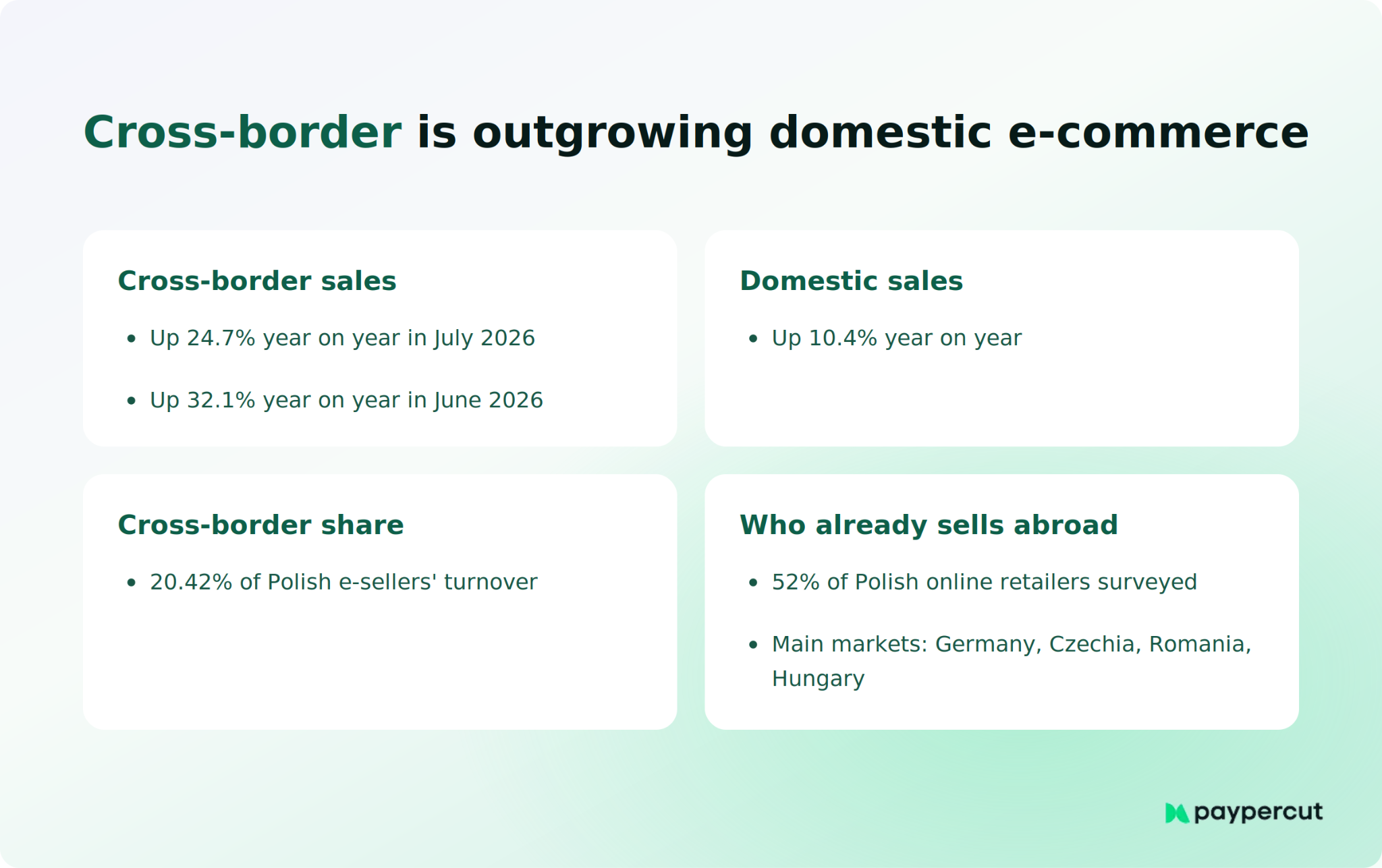
Polish e-commerce is already moving further in that direction. In July 2026, Base Index recorded 24.7% year-on-year growth in cross-border sales among the Polish merchants in its dataset. Domestic sales grew 10.4% over the same period.
That doesn't tell you when your company should switch provider. Your own order data does a better job of that.
Look at where sales are coming from now and compare it with six or twelve months ago. Then look at what the company is actually planning next.
If you're deliberately trying to make foreign sales bigger, the payment setup has to do more than accept an overseas Visa card.
A German customer may need to see a price in EUR. You may want a different mix of payment methods. Finance needs to know what happens to the EUR afterwards. Support needs to be able to find the transaction if something goes wrong.
None of this is a big deal for the occasional order.
It becomes a bigger deal once you've paid to acquire the customer.
And whatever you change internationally still needs to work alongside the way you already accept online payments in Poland.
2. You have a payment provider for every country
This tends to creep up on people.
The Polish provider is still there. Someone recommends another one for Czechia. Germany needs something the first two don't offer. One integration runs through a plugin, another has some custom development around it.
By the time finance gets involved, the setup looks less elegant than it did on the expansion roadmap.
There are different payout days. Different exports. Different transaction statuses. A refund starts in one dashboard and a failed German payment has to be found in another.
Nobody made a terrible decision.
Each provider probably had a perfectly good reason for being added at the time.
The annoying part is what happens after.
A small company might now have engineering maintaining several payment connections, finance reconciling several settlement files and customer support figuring out which provider handled which transaction.
You can get a decent sense of how far this has gone without doing a full payment audit.
Ask around:
- How many payment-provider accounts do we have?
- Who has access to all of them?
- Does finance reconcile them separately?
- If a payment fails abroad, does support know where to look?
- Would entering one more market mean adding one more provider?
If all of that is still easy, fine.
If the answers involve a surprising amount of “ask Marta, I think she has the login”, the operational side is probably starting to matter.
A local provider can still be the best option in a particular market. The issue isn't having more than one provider; it's collecting them by default every time you expand.
A local provider can still be the best option in a particular market. The issue isn't having more than one provider; it's collecting them by default every time you expand.
3. Going international means compromising on BLIK
This is where Poland makes the decision a bit more specific.
BLIK is already deeply embedded in Polish online payments. In the first half of 2026, it had 21.6 million active users, and consumers made 766.7 million online BLIK payments worth PLN 124.5 billion. E-commerce accounted for 48.5% of all BLIK transactions.
For a Polish consumer business, leaving it out isn't a tiny checkout preference.
And expansion shouldn't force you to.
If you find an international provider that covers every country on the roadmap but makes the Polish checkout worse, you've solved one problem by creating another one at home.
BLIK needs to sit alongside the cards, wallets and other payment methods Polish customers already use, while the rest of the setup can deal with customers elsewhere.
There's an extra reason not to think of BLIK as a strictly Poland-only issue anymore.
The system is itself expanding beyond Poland. BLIK has been building interoperability in Slovakia and the euro area, while recurring use is growing too. In H1 2026 it recorded 3.6 million recurring payments, twenty times the number from the same period a year earlier.
For an e-commerce store, the obvious question is whether BLIK is actually available.
For a SaaS or subscription startup, the next one may be how the method fits recurring billing over time.
And when you're comparing providers, be annoyingly specific about the word available.
“Supported” can mean a lot of things on a sales page.
Ask whether your Polish merchant account, on the integration you plan to use, can enable BLIK now.
That's a much easier answer to build a launch plan around.
BLIK support alongside international payments should be a normal requirement for a Polish startup expanding abroad, not an either/or decision.
4. Finance has started asking more questions than checkout
The payment succeeds. Then somebody has to account for it.
That second part gets more noticeable when PLN isn't the only currency moving through the business.
Say you're selling into Germany. The customer sees EUR. Your Polish company still pays salaries, taxes and plenty of suppliers in PLN.
So what happens between the EUR payment and the money arriving in your bank? There are two separate things to ask a provider about.
What does the customer pay in?
That's the checkout side.
If you've localised a German store properly, you probably don't want to finish the experience by showing everything in złoty and leaving the customer to work out what the purchase will cost them.
What does your business receive?
That's where settlement and FX come in.
Providers don't all handle this in the same way, and “we support eight currencies” doesn't answer the finance question.
Get specific:
It's easy to spend ages comparing whether one card rate is 0.2 percentage points cheaper and barely ask about the rest.
For EEA consumer cards, regulation already limits the underlying interchange fee to 0.2% on consumer debit cards and 0.3% on consumer credit cards in scope. That doesn't mean every provider charges merchants the same amount; interchange is only one piece of the eventual merchant fee.
FX is particularly worth getting in writing.
“Competitive exchange rates” sounds nice on a website but finance can't model it.
5. A market is ready and payments aren't
You hear this one in a planning call: “Germany can go live next month, but payments still need sorting.”
Maybe it happens once. Fair enough.
Then Czechia comes up six months later and somebody says almost the same thing.
If you've got this far, I'd ask the current provider to walk through the next launch properly before you add anything else.
Not: Do you support Germany? Something more like: We're already live in Poland. We want to launch in Germany. What exactly do we have to do?
- Do you need another agreement?
- Another merchant setup?
- More verification?
- New development?
- Can the currency and methods be enabled inside what you're already running?
- What changes for finance?
You don't need a slick answer. A slightly boring list of actual steps is much more useful.
It's also a decent way to separate providers that really handle multi-market merchants from those that simply accept international cards.
The same applies if you're comparing a new provider.
Don't ask how “scalable” the platform is.
Tell them Poland is live, Germany is next and Czechia is likely after that. See what the work looks like.
When staying put is the better option
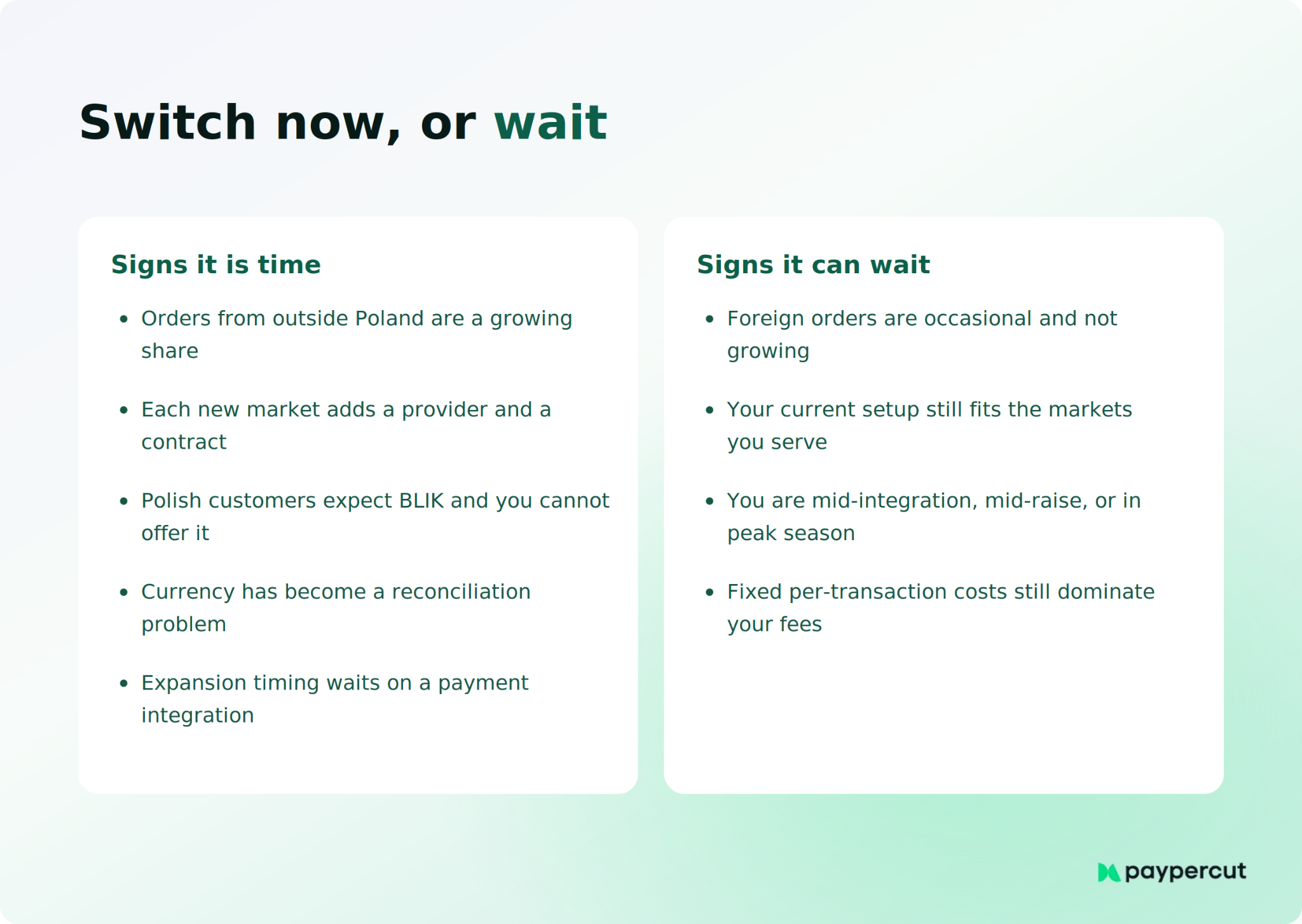
There is a completely valid outcome where you read all five signs and decide not to do anything yet.
If Poland is still essentially the whole business, your customers have the payment options they want and the current provider isn't causing operational pain, changing it would just create a project.
Leave it alone.
You also don't have to migrate the second you realise the setup probably won't suit you forever.
If the team is about to enter peak season, is halfway through another technical project or simply doesn't have a second market ready yet, there is not much glory in introducing payment-provider migration on top.
The useful part is knowing before you're under pressure.
You can compare your options now, understand the commercial terms and work out how difficult a migration would be. Then you have a choice about when to do it.
Before you switch, ask these 10 questions
We wouldn't choose a multi-market provider from a country map. And we definitely wouldn't choose one from the first card rate on the pricing page.
Use the markets you're actually planning and make the provider explain how each one works.
How much work is it to switch payment providers?
This depends much more on what you've already built than on how big the company is.
A WooCommerce store using a standard plugin and taking one-off payments is one job.
A SaaS company with recurring subscriptions, saved customer payment details, custom webhooks and finance tooling tied into the existing provider is another.
Before changing anything, list what the current provider touches:
- the checkout;
- payment methods;
- API calls or plugins;
- webhooks;
- refunds and disputes;
- subscriptions;
- saved payment details;
- transaction exports;
- finance and accounting;
- any notice period in your contract.
Some of it may be easy to move. Some of it may need to run in parallel for a while.
Subscriptions and stored payment details are usually the bits to raise early, because they can make a migration more involved than simply replacing the checkout integration.
For a custom build, give your developer more time. For subscriptions, start the conversation earlier.
And whatever your setup looks like, avoid treating the switch as one big flip. Test first, move live traffic once the new flow is working properly, and keep the old provider accessible while you still need historical transaction data, refunds or dispute records.
Where Paypercut fits into your expansion
We can support your payment setup from the beginning in Poland, while giving you room to expand when the next market is ready.
For Polish merchants, that means BLIK alongside cards and digital wallets, published local pricing, payouts to the business bank account you already use, and several ways to connect depending on how your store is built.
Our Polish pricing currently starts at 1.29% + PLN 0.25 for EEA consumer Visa and Mastercard, with the same transaction rate for BLIK, with no activation fee or monthly minimum.
If another market is already moving from idea to actual launch, you can look at the payment side early: which methods you’ll need there, which currencies matter, and what needs to change in your existing setup before customers arrive.
See Paypercut in action
Try the payment flow yourself and see how Paypercut could work for your setup in Poland and beyond.
FAQs
How do I know if my startup has outgrown a single-market payment setup?
A good sign is that entering another country now means adding a new provider, contract, integration or finance process. You don't need to hit a certain revenue level first; look at what your next market would actually require and whether the payment setup keeps getting rebuilt every time the business expands.
Do I need a multi-market provider if I only sell in Poland right now but plan to expand?
Not necessarily. If expansion is still just a future idea, choose the setup that works best for the business you have today and start comparing multi-market providers once another country has a real launch plan, budget or growing sales.
Does using a multi-market payment provider mean higher fees?
Not automatically. The transaction rate may be higher, lower or similar depending on the provider and your payment mix, so compare FX, local payment-method pricing, payouts, cross-border fees and any fixed costs too, not just the headline card rate.
Can a multi-market payment provider support BLIK alongside international payment methods?
Yes, if BLIK is live for your merchant account and integration. For a Polish startup, that means keeping BLIK in the Polish checkout while using cards, wallets and other supported methods for customers in other markets, so always check the exact setup available to you rather than relying on a generic country list.
How hard is it to switch from a single-market payment setup to a multi-market provider?
It depends on what your current provider is connected to. A plugin-based store taking one-off payments may have a fairly contained migration, while subscriptions, saved payment details, custom APIs, webhooks and accounting integrations can add more work, so map those dependencies before you switch.