

Payments in Poland have undergone significant changes in recent years. E-commerce growth, fintech innovation, and regulatory updates such as the Payment Services Directive 2 have accelerated the shift toward digital payments.
Polish consumers have embraced this shift. They are tech-savvy, security-aware, and now accustomed to the versatility of payment options. In fact, they are willing to abandon their purchase if they don’t see their preferred method at checkout.
For businesses entering or operating in Poland, understanding customer behavior and preferences is essential. This guide breaks down the most popular payment methods in Poland, who uses them, who offers them, and what they mean for your business.
Key takeaways
- Polish consumers have varied preferences and expect choice.
Payment cards are the most widespread method, followed by the mobile payment solution BLIK and bank transfers. Other choices include cash, Buy Now, Pay Later, and cryptocurrency.
- Offering various options helps you cater to different segments.
Digital wallets, BNPL, and cryptocurrency are more commonly used by the younger demographic, while older consumers tend to rely more on bank transfers than younger shoppers.
- Managing multiple methods and providers gets complicated quickly.
Each option may require a separate contract, integration, and compliance checks. Paypercut lets you implement and manage various payment methods from a single dashboard.
Payment methods in Poland at a glance
Here’s an overview of Poland’s main payment methods:
6 payment methods merchants should understand in Poland: Prevalence, leading services, and more
Payment preferences and habits of Polish consumers are varied. Sections below explore popular payment methods in Poland—from traditional payment cards to modern cryptocurrency.
If you want to do business in Poland, it’s best to offer as many payment methods as possible, as consumers demand versatility. Still, we’ve included pros and cons for each method, so you know what to expect and can prepare.
1. Payment cards
Payment cards are highly popular in Poland for both in-store and online payments. In 2024, they were used in 65% of transactions. Additionally, the number of cards increased by 1.7% from 2024 to 2025, and the number of merchants accepting online card payments rose by 6% over the same period.
The reason for their popularity? 83% of consumers feel secure and comfortable using them, and 75% trust them more than any other payment method. Merchants prefer cards because their benefits outweigh the costs, listing reasons such as excellent anti-fraud measures.
The most popular issuers are Visa and Mastercard, with PKO Bank Polski and Bank Pekao holding the biggest card market share.
Polish consumers strongly prefer debit cards over other types of cards, such as credit cards and prepaid cards. Debit cards make up around 90% of all card transactions today, and they’ve been the dominant type of card for over a decade.

It’s also worth noting that Poland has one of the highest levels of contactless card adoption in the world. Around 97% of its card transactions are contactless, and 100% of the country’s POS terminals support this payment method. This consumer behavior also shapes online expectations: Polish shoppers expect checkout to feel equally fast and low-friction.
Pros and cons of offering card payments
2. Digital wallets
Poland’s payment system has become significantly more digitalized over the last few years. Today, Poland is the leader in mobile and internet banking transactions, according to the 2025 EU Financial Centres Power Index.
Local mobile payment system BLIK is the most prevalent online payment method in Poland today. BLIK processed 1.39 billion transactions in the first half of 2025. It’s become significantly more popular over the past few years, achieving a 24% growth compared to H1 of 2024.
Global e-wallets such as Google Pay, Apple Pay, and PayPal are also frequently accepted in Poland, but they never matched the success of their local counterpart. For many Polish shoppers, seeing BLIK at checkout is also a trust signal. Its absence can hurt conversion even when cards are available.
Pros and cons of offering digital wallet payments
Zooming in on BLIK
BLIK was founded in 2015 by Polski Standard Płatności (PSP), a consortium of the six largest Polish banks. Today, BLIK is available across 19 bank applications. Besides Poland, it is also present in Romania and Slovakia, with plans to expand further.
To pay with BLIK, users need to connect it with their bank account and banking app first. Then, upon selecting BLIK as their payment method, they receive a unique 6-digit code in their banking app. The code allows them to make:
- Online purchases
- Contactless payments in-store
- Cash withdrawals via ATMs
- Peer-to-peer transfers, i.e., send money to friends and family
They can enter the code on the POS machine, online payment page, or ATM. To finalize the payment, the user needs to confirm it in the app within 60 seconds.
3. Bank transfer
Although not always as fast and efficient as digital wallet payments, bank transfers are highly prevalent, especially among older demographics. About 87% of merchants welcome this method, and 69% of consumers use it, with the latter figure surpassing the European average. Consumers usually appreciate the security and reliability of this method.
Bank transfers in Poland are highly advanced and digital. They’re supported by various networks and systems, including local BLIK, Elixir, Express Elixir, and Blue Cash.
Fintech solutions and providers like PayU, Przelewy24, and Sofort are also sought after for their ability to enable near-instant transactions, both locally and internationally. Many Polish shoppers use pay-by-bank flows (such as Przelewy24) that combine bank transfer rails with checkout-like user experiences.
Pros and cons of offering bank transfers
4. Cash
Despite the rise of digital solutions, cash is still in use among some segments. According to one study, cash payments accounted for 37% of merchants’ turnover in 2023 and 2024.
Cash is more common in less developed regions and is typically used for small everyday transactions and purchases from small businesses. It’s likely to become even less prevalent over time. The number of both cash transactions and ATMs has been declining steadily in the last ten years.
Besides accepting cash in physical stores, Polish merchants often provide the cash-on-delivery option. This method allows consumers to order a product and pay for it later by giving the cash to the delivery person, who then forwards it to the merchant.
Keep in mind that Poland still uses złoty (PLN) despite being in the EU. If you plan on working with Polish cash but your accounting is in another currency, you’ll need to account for the exchange rate.
Pros and cons of offering cash payments
5. Buy Now, Pay Later
Buy Now, Pay Later (BNPL) is a method that allows consumers to split the cost and pay it in installments over time. This method offers them flexibility and access to high-value products without putting a large dent in their budgets.
The demand for BNPL has been increasing rapidly since 2023. The current value of Poland’s BNPL market is 4.09 billion USD, and it’s expected to grow 21.3% annually to reach 10.72 billion in 2031. Some of the providers offering BNPL in Poland include PayU, PayPo, and DotPay.
About 70% of BNPL users are people under 35. This demographic typically can’t access formal credit or struggles with high interest rates, so BNPL emerged as a suitable alternative.
Pros and cons of offering BNPL
6. Cryptocurrency
The adoption of cryptocurrency in Poland is higher than in neighboring countries. While this method is still not as popular as BLIK or cards, its usage is significant and growing rapidly, especially in the 19–24 age group. The most common reasons for adoption include increased security and anonymity of transactions, protection against oversight, and convenience of use.
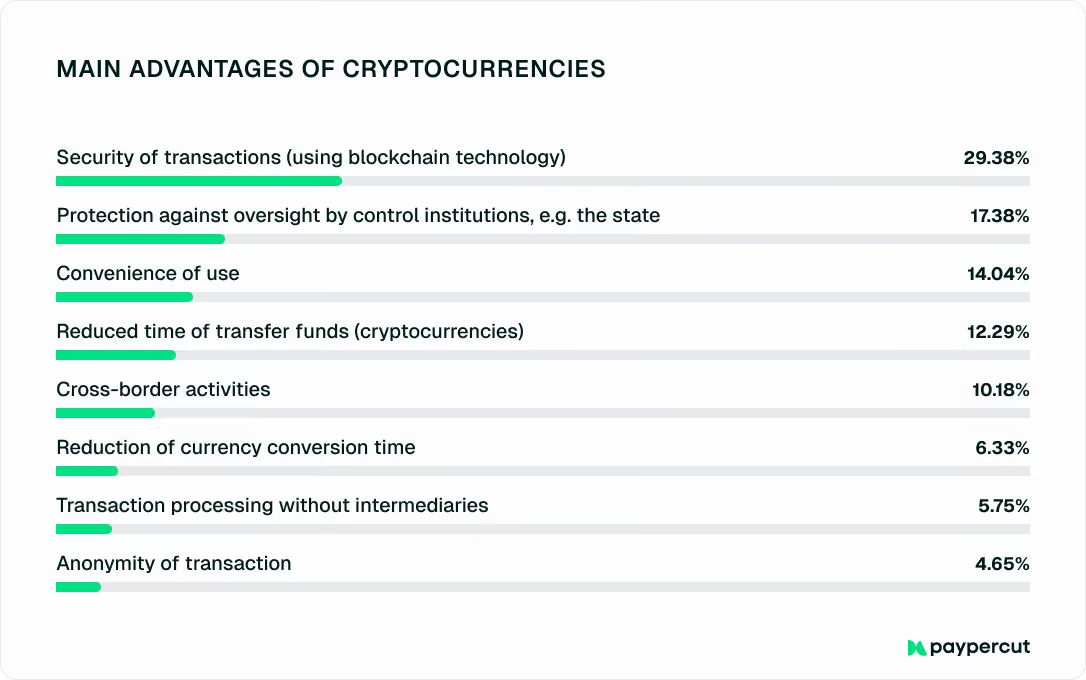
In one survey, about 20% of Poles reported investing in crypto in mid 2025. Nearly half entered the market within the past year, and over 65% used crypto for payments.
The most popular cryptocurrencies include Bitcoin, Ethereum, XRP, Solana, and Monero, while the most downloaded app is Binance.
Pros and cons of offering cryptocurrency payments
Final words on Poland’s payment methods
Poland's payment market offers plenty of opportunities, but also requires careful planning. Above all, you should offer a wide range of payment options to avoid losing a significant portion of sales.
Implementing all of these payment methods is challenging. Each method comes with specific technical and legal specificities, requiring tedious work such as reviewing and signing contracts, ensuring compliance, and adapting your payment gateways. For a small business, these complexities can be a major bottleneck that drains precious resources.
The good news is that using a platform like Paypercut can make it easy to add new payment methods, manage them, and expand to the Polish market and beyond.
How Paypercut helps you accept payments in Poland
Paypercut is a payment platform designed for SMBs expanding across Central and Eastern Europe. With Paypercut, you can set up and manage payments via Poland’s preferred methods, including cards, digital wallets, and BNPL, and, soon, BLIK.
The best part? You can do it all from a single dashboard.

You sign up once, integrate Paypercut with your website via plugin or API, and gain access to the payment methods you need without negotiating with each provider individually. Paypercut helps simplify compliance requirements around PSD2, GDPR, and KYC onboarding.
Once you’re live, you can offer payments in PLN as well as over 11 other currencies, and thus avoid FX and international transaction fees.
Paypercut gives you access to many products, features, and benefits, including:
- Various integration options: Set up payments via hosted or embedded checkout. Alternatively, use plugins for popular e-commerce platforms like Shopify.
- QR codes and payment links: Accept payments in Poland even if you don’t have a website or online store.
- Straightforward pricing: You pay only for transactions, specifically successful ones. There are no setup charges and monthly contracts that lock you in.
- Flexible BNPL options: Use Paypercut as a BNPL provider or standalone aggregator. Get paid upfront or select the more cost-effective merchant-funded BNPL.
- Actually helpful support: If you have questions or run into a problem, you’ll get to talk to local experts instead of chatbots.
- Expansion beyond Poland: Paypercut lets you accept payments from 29 other countries and scale with ease.
Contact Paypercut today and offer Polish shoppers the payment methods they expect—without managing five different integrations.