
Greece stands out in the European Union for its turbulent financial history.
The debt crisis in the country left a lasting impact on both consumers and businesses, shaping how people pay and whom they trust.
As for the government, it has been actively promoting electronic payments to increase transparency and reduce tax evasion, with incentives, regulations, and stronger security standards encouraging a shift away from cash.
This leaves merchants operating between traditional and digital payments, which makes the Greek payments landscape more challenging to navigate.
To help you succeed under these circumstances, this guide breaks down the local payment landscape and shows you how to accept payments in Greece, so you can offer the right payment options and grow your business in the country.
Key takeaways
- Card payments are now the dominant growth driver in Greece
While cash has historically led the market, card usage has surged over the past decade. Consumers trust cards, merchants see clear benefits, and card acceptance infrastructure is widespread, making card payments essential for businesses selling in Greece.
- Digital payments are growing, but trust still matters
Greece is gradually adopting digital payment methods such as digital wallets, instant bank transfers, and online payments. However, lingering caution from the financial crisis means customers often prefer familiar, trusted payment options and brands.
- Local preferences can directly impact conversion rates
Greek consumers strongly favor local businesses and recognizable payment methods. Businesses that offer a localized checkout experience with trusted payment options are more likely to earn customer confidence and complete more sales.
- Offering multiple payment methods is critical for success
Cards, bank transfers, digital wallets, cash, and Buy Now Pay Later (BNPL) all play important roles in the Greek market. Supporting a broad mix of payment methods helps businesses meet customer expectations and reduce checkout abandonment.
- A secure, compliant payment partner can accelerate market entry
Beyond offering the right payment methods, businesses must meet PSD2, GDPR, SCA, and other EU requirements. Paypercut simplifies this process through a single integration that supports secure payment acceptance, built-in compliance, fraud protection, and scalable payment infrastructure, helping merchants expand into Greece with less operational complexity and greater customer trust.
Understanding the Greek payments landscape: 5 key facts
Greece is a eurozone country with roughly 10 million people and the largest economy in Southeast Europe.
Its economy is service-based, especially tourism and shipping, creating a diverse payments environment where businesses serve both local customers and international visitors.
The five facts below will give you a clearer picture of what this environment looks like.
1. The financial crisis still shapes payment behavior in Greece
Many Greek consumers remain cautious about financial institutions and digital payments.
As a result, familiar and established payment methods continue to have an advantage.
2. Greece is gradually shifting from cash to cards and digital payments.
Cash has traditionally dominated payments in Greece, but this is steadily changing.
Cash accounted for 70% of point-of-sale (POS) transactions in 2017, but its use has since declined significantly.
In contrast, card adoption has grown impressively fast, with card transactions increasing 25 times in volume and 10 times in value between 2014 and 2024.
The total number of cards in circulation has also been rising, reaching 22.67 million in 2024—more than double the country’s population.

This growth is supported by better infrastructure, with over 1.2 million POS terminals now available across the country.
Both consumers and merchants are embracing this shift, as shown by the following data:
- 71% of consumers see cards as more valuable than other payment methods.
- 68% of consumers trust cards more than other payment methods in Greece.
- 77% of merchants say cards bring more benefits than costs.
- 83% of merchants expect digital payments to increase further.
3. Digital payment adoption is growing steadily, but progress remains gradual
While digital payments are becoming more common, Greece is still catching up with other European countries.
This slower transition is partly due to factors like lower digital literacy and lingering caution after the financial crisis.
Still, the government is actively investing in digitization and expanding online services, while banks and fintech companies continue introducing more modern payment solutions.
4. Greece has a well-regulated payments system supported by national and EU authorities
Several institutions oversee the payments ecosystem in Greece, ensuring stability, security, and transparency for both businesses and consumers:
- The Bank of Greece: This institution regulates payment and electronic money institutions, sets operating standards, and conducts audits to ensure compliance.
- The Hellenic Capital Market Commission: This body supervises financial markets and protects transparency.
- The Hellenic Data Protection Authority: This independent public authority ensures businesses handle customer payment data securely and follow data protection laws.
At the European level, Greece follows common frameworks like the Single Euro Payments Area (SEPA), which enables fast and standardized euro bank transfers across EU countries.
This strong regulatory environment helps create a secure and reliable payments market.
However, it also means that merchants must work with compliant payment partners to operate smoothly and build customer trust.
5. Greek customers prefer local and familiar businesses
Greece’s e-commerce market is expanding rapidly, with 76.7% of consumers already shopping online regularly.
However, these customers show a strong preference for domestic merchants, with 84.4% of Greeks choosing to buy from local e-shops.
This just reiterates how important trust and familiarity are in the Greek market.
Customers are more likely to buy from businesses that offer a localized experience, including payment methods they recognize and trust.
The 5 most popular payment methods in Greece
If you want to accept payments in Greece successfully, it’s essential to offer the payment methods customers already use and prefer.
The five methods below are the most widely used and expected at checkout, making them key to reaching more customers and maximizing conversions.
1. Cards
Card payments make up 47% of Greek merchants’ turnover, making them the most popular payment method in Greece.
Debit cards are especially common, as they are typically issued automatically with bank accounts, while credit cards are widely used for larger purchases and online shopping.
Together, cards are commonly used for:
- Online purchases, including e-commerce, subscriptions, and travel bookings
- Everyday spending, such as supermarkets, fuel, and utility payments (around 40% of card payment value)
- Hospitality and tourism, including hotels, restaurants, and travel services
- Retail stores, especially in urban areas and shopping centers
As for the card schemes used in Greece, the table below shows the most common networks and where they are typically used:
2. Cash
Cash has historically been the dominant payment method in Greece, and it’s still widely used today, especially by older consumers and in traditional businesses like cafés, bakeries, and tavernas.
Many customers prefer cash for everyday purchases, such as coffee, groceries, and local services, because it feels familiar and gives them more control over their spending.
Besides traditional businesses and everyday purchases, cash is commonly used for:
- Purchases in rural areas and smaller towns, where digital adoption is slower
- Cash-on-delivery (COD) orders, especially for apparel and household goods
- Peer-to-peer payments
Still, cash usage is steadily declining.
Today, cash accounts for 39% of merchant turnover, and merchants expect cash usage to drop further to 26% in the next five years.
This expected drop is driven by practical factors.
Card acceptance is now widespread, digital payments are faster and easier to manage, and regulations increasingly limit large cash transactions.
For merchants, digital payments also simplify accounting and reduce the operational burden of handling physical cash.
3. Bank transfers
In Greece, bank transfers are common for paying bills, making larger purchases, and handling business transactions, as they allow customers to pay directly from their bank accounts.
Common scenarios include paying:
- Utility bills, rent, and government services
- Supplier payments and payroll
- Higher-value purchases, where customers avoid using cards
- Instant account-to-account payments
In just two years, from 2022 to 2024, the share of Greek consumers who have access to instant payments jumped from 33% to 62%.
One of the key drivers of this growth is IRIS, the local instant payment system, which is used by 4.2 million people in the country.
4. Online payments and digital wallets
Although cards remain the main digital payment method, customers are increasingly using mobile devices and digital wallets to complete purchases faster and more conveniently.
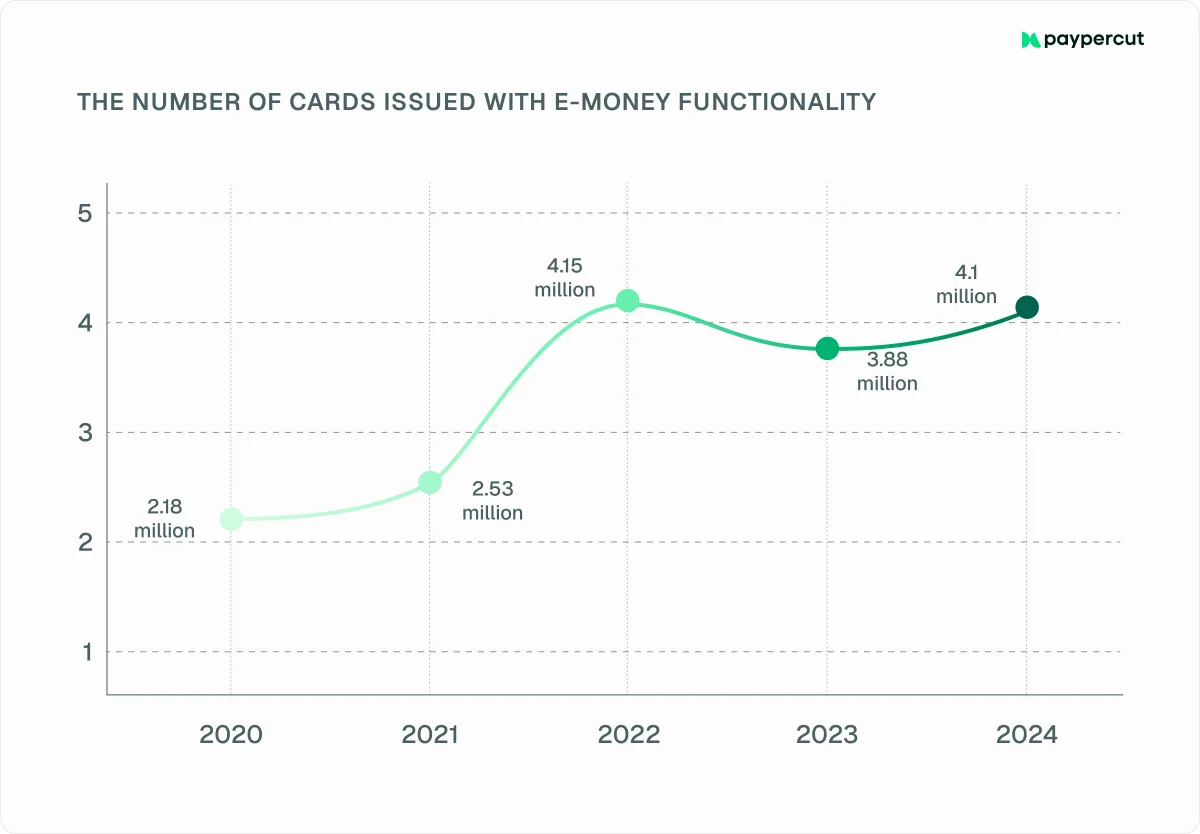
This shift is also reflected in the rapid growth of cards with e-money functionality—cards that can be stored in digital wallets and used for online and mobile payments.
The number of these cards nearly doubled, from 2.18 million in 2020 to over 4.1 million in 2024, showing strong adoption of wallet-based payments.
Digital wallets are commonly used by tech-savvy younger customers who rely heavily on their smartphones for everyday purchases.
While there are many international and local options available, Apple Pay and Google Pay remain the most widely used digital wallets. Both are supported by major Greek banks and are widely accepted across e-commerce and retail.
5. Buy Now Pay Later
Buy Now, Pay Later (BNPL) is the fastest-growing online payment method in Greece.
It allows customers to split the cost of a purchase into smaller installments, often without interest, making higher-value items more affordable.
BNPL is commonly used for:
- Higher-value e-commerce purchases, such as electronics, furniture, and appliances
- Fashion and retail, where customers prefer spreading out payments
- Online stores targeting younger customers, who prefer flexible payment options
And this list is likely to expand as the BNPL market in Greece continues to grow rapidly.
By 2030, this market is expected to reach €5.21 billion, tripling its 2025 value of €1.72 billion.
Customer demand is certainly strong, with 53% of consumers willing to choose BNPL over credit cards for flexible payments.
Both local and international providers are taking advantage of this growth, with Klarna, TBI Bank, and Finloup being the key players in the Greek BNPL market.
How to accept payments in Greece successfully: 5 best practices
Although Greece’s payments landscape is modernizing quickly, it’s still heavily shaped by local customer preferences, economic factors, and regulations.
Understanding these specifics is essential for offering the right payment experience.
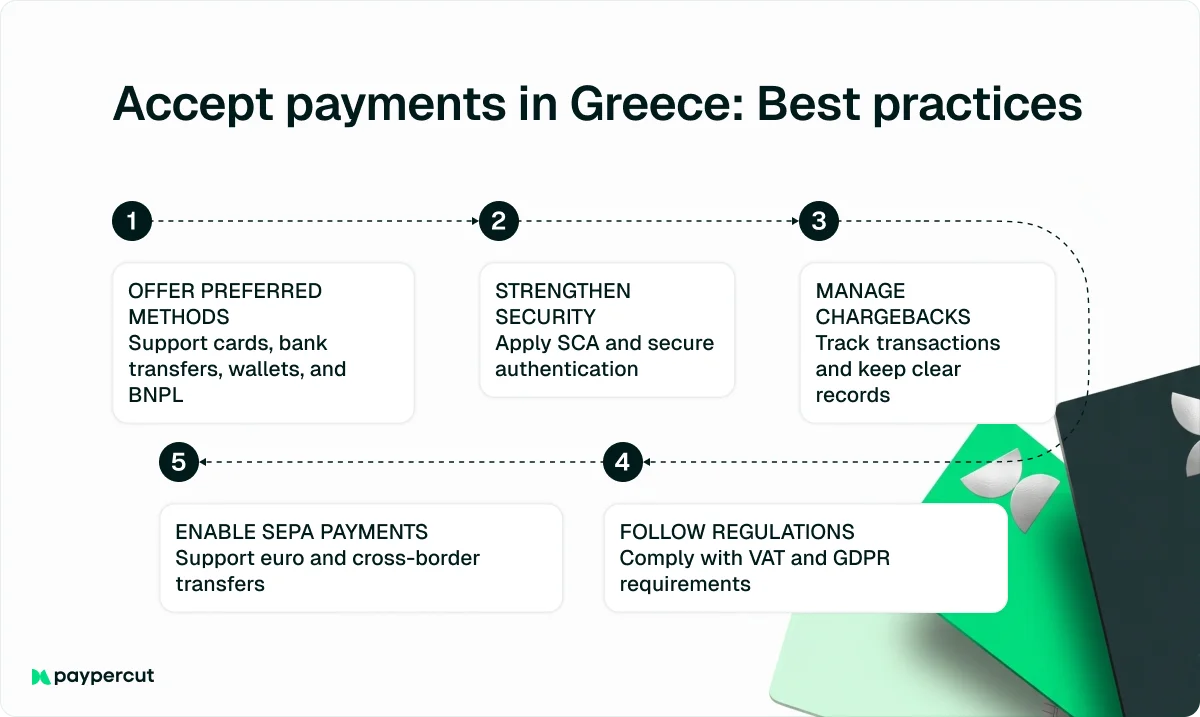
With this in mind, here are the five best practices to consider when entering or growing in the Greek market.
- Offer the payment methods Greek customers prefer: Supporting cards, bank transfers, digital wallets, and BNPL ensures you can serve different customer preferences and avoid losing sales.
- Use strong security and authentication measures: Secure payments and Strong Customer Authentication (SCA) help protect your business and reassure customers who value safe transactions.
- Prepare for chargebacks and keep detailed records: Clear documentation and transaction tracking make it easier to resolve disputes and protect your revenue.
- Comply with local tax and data protection regulations: Following VAT rules and GDPR requirements helps you avoid penalties and operate smoothly in the Greek market.
- Support SEPA and cross-border payments: Enabling easy euro transfers allows you to serve customers across Greece and the wider EU without friction.
Accept payments in Greece securely with Paypercut
For merchants entering the Greek market, offering the right payment methods is only part of the equation.
You also need a payment infrastructure that meets local and European security standards, protects customer data, and keeps you compliant as regulations evolve.
After all, safety and reliability are key factors in how customers choose to pay in Greece.
Paypercut helps businesses accept online payments in Greece through a single integration while handling the complexity of compliance and security in the background.
With Paypercut, you benefit from:
- PCI-DSS certified infrastructure for secure card payment processing
- Strong Customer Authentication to meet PSD2 requirements and reduce fraud
- End-to-end encryption to protect sensitive customer and payment data
- EU-regulated payment processing through a provider licensed by the Dutch National Bank
- Built-in compliance support for European payment and data protection requirements
These features allow you to focus on growing your business while relying on a secure, compliant, and scalable payment setup designed for European markets.
If Paypercut checks all the important boxes for your business, you can sign up immediately and start accepting payments.
To learn more or find the right configuration for your needs, schedule a consultation with the Paypercut team first.
FAQ
Does Greece accept card payments?
Yes. Card payments are widely accepted in Greece, both online and in-store, with Visa and Mastercard being the most common.
Which payment methods are available in Greece?
There are multiple payment methods available in Greece, including cards, bank transfers, digital wallets (Apple Pay, Google Pay), cash, and Buy Now, Pay Later (BNPL).
Does Greece have Zelle?
No. Zelle isn’t available in Greece. Local alternatives include bank transfers and the IRIS instant payment system.
Do I need to comply with PSD2 when accepting payments in Greece?
Yes. As an EU member state, Greece follows PSD2 regulations.
How do chargebacks work in Greece?
Chargebacks in Greece follow both EU regulations and local commerce rules. Transactions authenticated through PSD2’s SCA are generally easier for merchants to defend against chargeback claims, as they include additional verification steps.
What are the settlement times for online payments in Greece?
It depends on the payment method. Transactions made via IRIS clear immediately, while standard card and digital wallet payments typically settle within one to three business days.