
On 1 September 2026, a new receipt data-reporting obligation takes effect in Hungary. How much it changes for your webshop depends on whether you issue receipts or invoices for online sales.
But it lands in the same year that qvik acceptance started spreading and prepaid orders climbed toward half of all baskets, and together those three things have quietly changed what a good payment setup looks like here.
Which is awkward timing, because the payment gateway is usually the last thing a Hungarian store owner picks. Often in an afternoon. Usually on price.
There are really three things worth getting right: what each order costs you, what your customers can do at checkout, and how much admin the setup creates.
Here is how to work through all three.
Key takeaways
- Compare the all-in cost of one average order, not just the percentage. Fixed transaction fees, payout costs and pricing conditions can change which provider is actually cheaper.
- Check which payment methods are live for Hungarian merchants today. Cards and wallets are the baseline, while qvik is becoming a more relevant local option.
- NAV matters to your payment setup indirectly. Your invoicing or accounting system handles the reporting, but clean transaction data makes reconciliation much easier.
- Settlement speed is a working-capital term. Ask how many days it takes, whether payouts cost extra and whether the money goes directly to your bank.
- Integration and support belong in the comparison too. A cheap gateway is less attractive if the plugin is poorly maintained or every issue turns into manual admin.
What makes the Hungarian setup different
Most gateway advice is written for eurozone merchants. If you run a Hungarian webshop, there are a few local realities that should shape the way you compare providers.
Your day-to-day business runs in HUF. The question is not whether a gateway supports forints, but what happens around them: how you receive payouts, what that costs, and how easily you can add EUR or other currencies if you also sell outside Hungary.
NAV affects the admin around payments. Your gateway does not determine your NAV reporting obligation. Your invoicing or accounting setup does. What matters on the payment side is whether transaction data is easy to match with invoices, refunds and payouts, or whether someone on your team ends up doing that work manually.
From 1 September 2026, new reporting requirements also apply to manual and computer-generated receipts. NAV has confirmed a transition period through 31 December 2026, with the normal penalty regime applying from January 2027. Whether this affects your webshop depends on how you document sales, so confirm your own setup with your accountant.
qvik is becoming harder to ignore. Hungary's domestic instant-payment option launched in 2024 and now sits alongside cards, wallets, BNPL, bank transfers and cash on delivery in the wider mix of payment methods used in Hungary. It works through local mobile banking apps and is free for consumers to use, while merchant acceptance is priced separately by the provider.
Usage is still much smaller than card payments, but it is growing. MNB data show qvik gaining traction through late 2025 and into 2026, so “do you support qvik?” now belongs on the shortlist of questions you ask a Hungarian payment provider.
That is really the local layer to keep in mind: HUF settlement, clean reconciliation around NAV, and support for the payment methods Hungarian shoppers actually use.
That is really the local layer to keep in mind: HUF settlement, clean reconciliation around NAV, and support for the payment methods Hungarian shoppers actually use.
Question one: what does one average order cost you?
Not the percentage. The order.
Three things sit on top of any advertised rate, and each behaves differently depending on your basket size.
The fixed amount per transaction
This is the sleeper. A rate of 1.5% + HUF 85 sounds close to a flat 1.49%, and on a big basket it is.
On a small one it is not close at all.
Using Stripe's Hungarian pricing, a standard EEA card at 1.5% + HUF 85 works out at roughly 1.93% on a HUF 20,000 order, 1.67% at HUF 50,000, and 1.59% at HUF 100,000. One published rate, three real prices.
If your average order is small, pay close attention to the fixed component. As basket size rises, it matters less.
The cost of getting your money out
Some providers hold your money in a balance first. Moving it to your bank is then a separate priced action.
Barion's current pricing, valid from 22 April 2026, prices HUF withdrawals to a Hungarian bank account at 0.10%, with a minimum fee of HUF 70.
Trivial per payout. Less trivial across a year.
The conditions on the good rate
This is the one people skip.
Barion's Fix pricing comes with conditions: the average monthly basket must be at least HUF 10,000, while corporate and foreign consumer cards together cannot exceed 2% of monthly turnover.
Barion reviews those conditions monthly. If they are no longer met, the merchant can be moved to the corresponding IC++ package and cannot later return to Fix.
That is not unusual in payments. It is simply something you want to know before a change in customer mix changes what you actually pay.
Run your own numbers
Take 250 orders a month at a HUF 16,000 basket. HUF 4 million monthly, nearly all EEA consumer cards, one payout a month.
Here is what Hungarian shoppers reach for.
Now drop the basket to HUF 3,000 and the top two swap places, because the fixed amounts start to dominate.
Which is the whole point. Your basket decides the winner, not the marketing.
One caveat on comparisons. SimplePay prices online merchants by individual quote rather than a published rate, so you cannot model it in advance. Ask for the offer in writing, with the one-time connection fee shown separately from the transaction commission. A percentage quoted without the connection fee is not a price.
Question two: what can your customers actually do at checkout?
A fee difference costs you a few thousand forints a month. A missing payment method costs you the whole order.
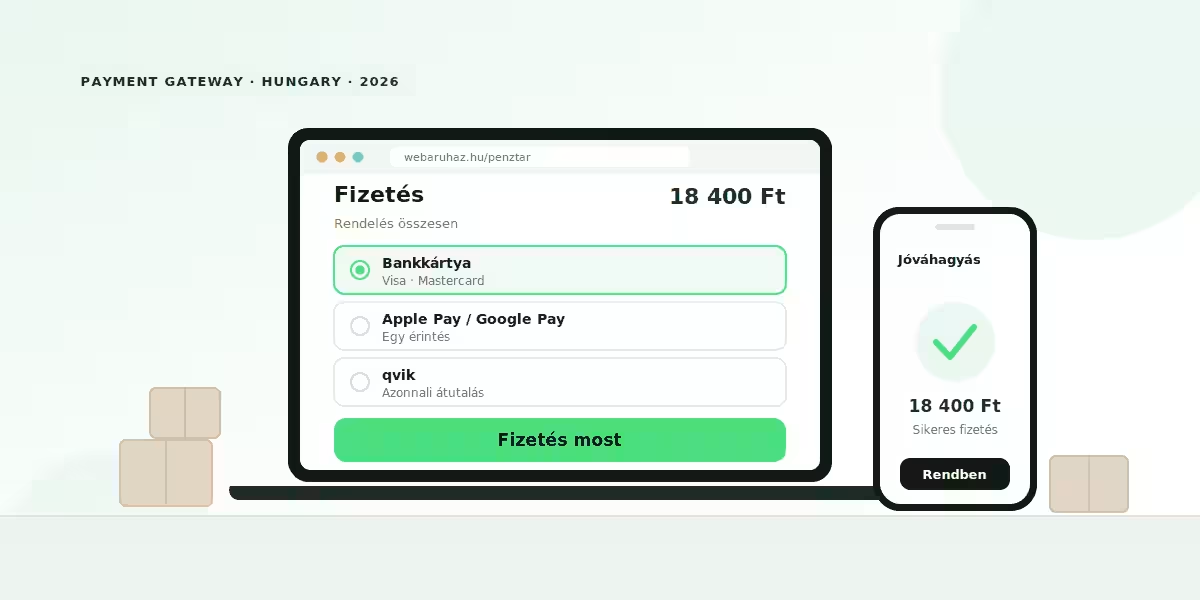
Here is what Hungarian shoppers reach for.
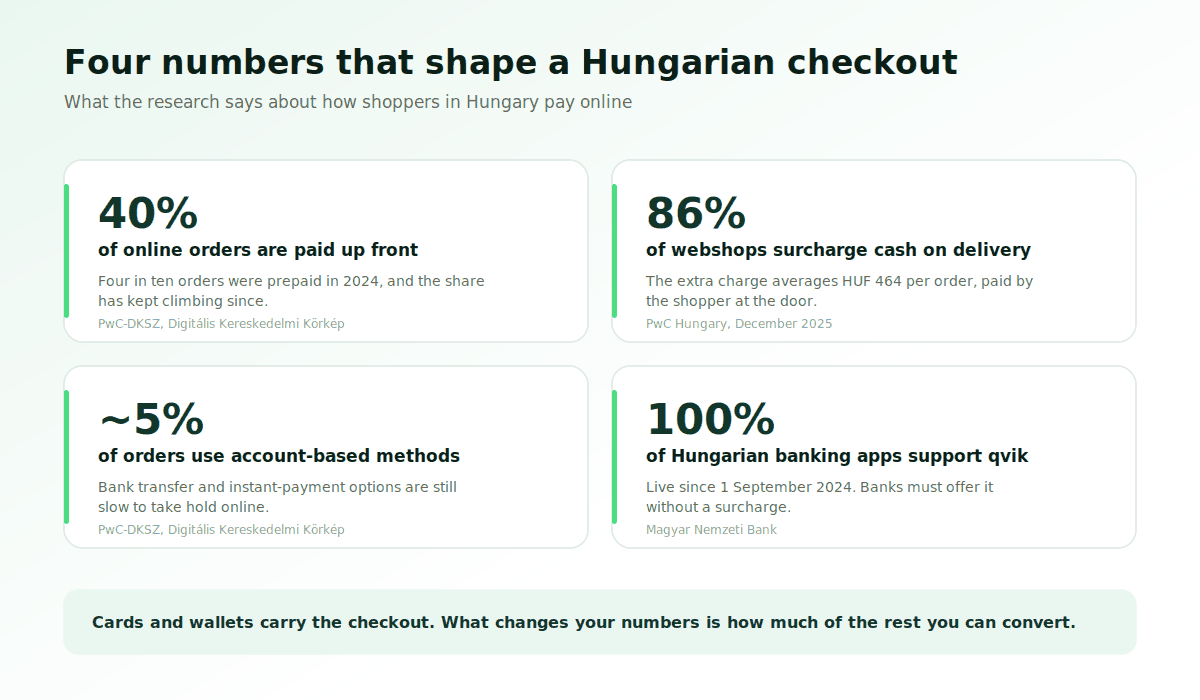
Cards and wallets. Visa and Mastercard cover nearly the entire market. Apple Pay and Google Pay are now assumed rather than impressive. Commentary alongside the PwC-DKSZ Digitális Kereskedelmi Körkép treats one-click flows, saved cards and tokenized transactions as baseline.
Cash on delivery. Still substantial, and it costs you. PwC found that 86% of webshops offering COD charge extra for it, averaging HUF 464. That surcharge is doing conversion work you would rather do with a better prepaid experience.
qvik. Worth checking wherever your provider supports it. For online stores, QR and deeplink-based payment flows are the relevant formats. Merchant acceptance is priced separately, so compare the actual commercial terms rather than assuming instant payment automatically means free acceptance.
BNPL. Tends to move basket size rather than order count.
Bank transfer. Still slow to catch on. Per the same research, account-based methods sit at roughly 5% of online orders.
Important: qvik is still much smaller than card payments, but adoption is moving quickly enough that Hungarian stores should now treat support for it as a real comparison point rather than a future nice-to-have.
qvik is still much smaller than card payments, but adoption is moving quickly enough that Hungarian stores should now treat support for it as a real comparison point rather than a future nice-to-have.
One thing to insist on. Ask every provider for the methods live for a Hungarian merchant today, in writing, with a date on the message. Several methods have been "coming soon" in this market for years.
Question three: how much of your week does it take?
The costs nobody quotes you are the ones that arrive as hours.
Does the plugin exist, and does it work?
WooCommerce, Shopify, Shoprenter, UNAS, OpenCart, Magento, PrestaShop. The question is not whether a provider lists your platform. It is when the plugin was last updated, and who maintains it.
Look at the changelog, not the logo on the partner page.
Does it fit your invoicing?
Számlázz.hu and Billingo are where most Hungarian stores handle this. Some providers, SimplePay among them, market NAV Online Számla integration as a headline feature precisely because merchants ask about it first.
If your reconciliation currently means manually matching a payout against a batch of invoices, this is where you win back your Friday afternoons.
Can you build while you wait?
Verification takes what it takes. What you control is whether integration work runs alongside it or after it.
If a sandbox opens on day one, your developer builds during the week compliance is still reading your documents. If it does not, the two run end to end and your launch slips by the length of verification.
Ask to see the sandbox before signing anything. A provider who will not show you the test environment is telling you something about the documentation.
How fast does the money arrive?
Settlement speed decides what stock you can order this month. Get it as a number of days, not as "fast payouts."
Then two follow-ups. Does the payout carry a fee, and does that change for a non-HUF currency? And does money go to your bank, or to a balance you have to move yourself?
The balance model is not worse, just different. Some merchants like the float. Others find it an admin step nobody in the business owns.
Who picks up the phone?
"Great support" means nothing. "A named contact reachable in Hungarian during onboarding, plus a documented escalation path after go-live" is something you can hold a provider to.
When a broken checkout costs an hour of revenue, response time is a commercial term.
And what happens if you leave?
Ask before you join. Minimum term, early termination fee, and whether you can export your full transaction history.
You want to understand the exit before it becomes urgent.
The list to take into the call
Print this, or paste it into the email.
Security should be a baseline, not an assumption. Check PCI DSS compliance and how the provider handles PSD2 strong customer authentication and 3-D Secure.
Then test the actual checkout. A payment flow can meet the technical requirements and still create unnecessary friction for customers.
Local, international, or both?
Go local if local checkout recognition, qvik support or a particularly strong fit with your existing Hungarian invoicing setup are your main priorities. Established providers such as SimplePay and Barion combine local familiarity with payment options built around the Hungarian market.
Go international or regional if the provider gives you the right combination of pricing, checkout experience, integration, settlement and support. You do not need to be selling outside Hungary for one of these platforms to make sense. Cross-border capabilities simply give you more room to grow later without changing your payment setup.
Running two providers side by side can also be a reasonable choice. It can give customers another payment route and provide redundancy if one checkout is unavailable.
A more modern option for Hungarian online stores
If your current provider works but the setup feels dated, expensive to manage or harder to integrate than it should be, Paypercut is worth comparing on the same criteria above.
For Hungarian merchants, that means published pricing, payouts to your existing business bank account, modern checkout options and support from real people when you need it.
And if you later sell beyond Hungary, you can keep the same payment setup across supported European markets rather than starting again from scratch.
Ready for a payment setup that works better?
See how Paypercut handles pricing, payouts and checkout for Hungarian online stores.
FAQs
What fees should I compare between payment gateways in Hungary?
Compare the total cost of an average order rather than the headline percentage. That means the percentage rate, any fixed per-transaction amount, the payout or withdrawal fee, the chargeback fee, any one-time connection fee, and add-ons for recurring billing. Also check the conditions attached to a preferential rate, such as a minimum average basket or a cap on foreign and corporate cards, because those clauses decide what you actually end up paying.
Does the payment gateway support the local payment methods Hungarian shoppers actually use?
Ask each provider for a written, dated list of methods currently live for a Hungarian merchant. Cards, Apple Pay and Google Pay are the baseline. Beyond that, check qvik, BNPL, bank transfer, and how you plan to handle cash on delivery, which most Hungarian webshops now surcharge by around HUF 464. Roadmap items are not the same as methods you can show at checkout tomorrow.
How important is settlement speed when choosing a payment gateway?
Settlement speed determines your working capital, so it matters most if you buy stock on supplier terms or run tight margins. Ask for the standard payout schedule as a number of days, ask whether the payout carries a separate fee, and ask whether money goes straight to your bank account or to a provider-held balance you then have to withdraw manually.
Can I switch payment gateways later without disrupting my store?
Yes, and it is common. Most disruption comes from contract terms rather than technology, so check minimum terms and early termination fees before you join. The low-risk method is to integrate the new gateway, run test transactions in a sandbox, keep the existing method live in parallel for a short period, then switch the default once the new flow is proven. Export your transaction history before closing the old account.
Should a small Hungarian online store choose a local or international payment gateway?
Either can work. If local payment methods and familiarity are your top priorities, a Hungarian provider may be the better fit. But an international or regional platform can make just as much sense, even if you only sell in Hungary, if the pricing, checkout, payouts, integration and support work better for your business. Paypercut is built to support Hungarian merchants from the start, with the added benefit that the same setup can support you if you expand into other markets later.